Ch 05: Applying Newton's Laws
Young & Freedman Calc - University Physics 15th Edition
Young & Freedman Calc15th EditionUniversity PhysicsISBN: 9780135159552Not the one you use?Change textbook
Chapter 5, Problem 16a

An 8.008.00-kg block of ice, released from rest at the top of a 1.501.50-m-long frictionless ramp, slides downhill, reaching a speed of 2.502.50 m/s at the bottom. What is the angle between the ramp and the horizontal?

Verified step by step guidance
1
Step 1: Begin by identifying the known quantities in the problem. The mass of the block is 8.00 kg, the length of the ramp is 1.50 m, the final speed at the bottom of the ramp is 2.50 m/s, and the ramp is frictionless. The goal is to find the angle between the ramp and the horizontal.
Step 2: Use the principle of energy conservation. Since the ramp is frictionless, the mechanical energy is conserved. The potential energy at the top of the ramp is converted into kinetic energy at the bottom. Write the energy conservation equation: \( m g h = \frac{1}{2} m v^2 \), where \( h \) is the vertical height, \( g \) is the acceleration due to gravity, and \( v \) is the final speed.
Step 3: Solve for \( h \) (the vertical height). Rearrange the energy conservation equation: \( h = \frac{v^2}{2 g} \). Substitute \( v = 2.50 \, \text{m/s} \) and \( g = 9.8 \, \text{m/s}^2 \) into the equation to calculate \( h \).
Step 4: Relate the vertical height \( h \) to the length of the ramp \( L \) and the angle \( \theta \). Using trigonometry, \( \sin \theta = \frac{h}{L} \). Substitute \( h \) and \( L = 1.50 \, \text{m} \) into the equation to solve for \( \sin \theta \).
Step 5: Finally, calculate the angle \( \theta \) by taking the inverse sine (arcsin) of \( \sin \theta \). This will give the angle between the ramp and the horizontal.

Verified video answer for a similar problem:

This video solution was recommended by our tutors as helpful for the problem above.
Video duration:
7m
Was this helpful?

Key Concepts

Here are the essential concepts you must grasp in order to answer the question correctly.

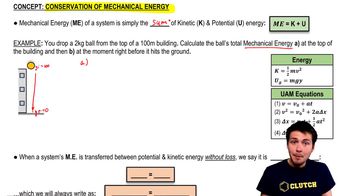
Conservation of Energy

The principle of conservation of energy states that energy cannot be created or destroyed, only transformed from one form to another. In this scenario, the potential energy of the ice block at the top of the ramp is converted into kinetic energy as it slides down. This relationship allows us to calculate the height and speed of the block at different points along the ramp.
Recommended video:
Guided course
06:24
Conservation Of Mechanical Energy

Kinetic Energy

Kinetic energy is the energy an object possesses due to its motion, calculated using the formula KE = 1/2 mv², where m is mass and v is velocity. In this problem, the block of ice reaches a speed of 2.50 m/s at the bottom of the ramp, which means it has a specific amount of kinetic energy that can be related to its initial potential energy at the top.
Recommended video:
Guided course
06:07
Intro to Rotational Kinetic Energy

Inclined Plane Geometry

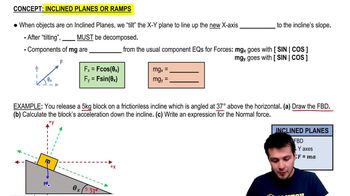
The geometry of an inclined plane involves understanding the relationship between the angle of the ramp, the height of the ramp, and the length of the ramp. The angle can be determined using trigonometric functions, specifically sine and cosine, which relate the height and length of the ramp to the angle. This is essential for solving the problem and finding the angle between the ramp and the horizontal.
Recommended video:
Guided course
06:59
Intro to Inclined Planes
Related Practice
Textbook Question

Three sleds are being pulled horizontally on frictionless horizontal ice using horizontal ropes (Fig. E5.145.14). The pull is of magnitude 190190 N. Find the acceleration of the system.

2
views
Textbook Question

A light rope is attached to a block with mass 4.004.00 kg that rests on a frictionless, horizontal surface. The horizontal rope passes over a frictionless, massless pulley, and a block with mass mm is suspended from the other end. When the blocks are released, the tension in the rope is 15.015.0 N. What is the acceleration of either block?

3
views
Textbook Question

An 8.008.00-kg block of ice, released from rest at the top of a 1.501.50-m-long frictionless ramp, slides downhill, reaching a speed of 2.502.50 m/s at the bottom. What would be the speed of the ice at the bottom if the motion were opposed by a constant friction force of 10.010.0 N parallel to the surface of the ramp?

1
views
Textbook Question

On September 8, 2004, the Genesis spacecraft crashed in the Utah desert because its parachute did not open. The 210210-kg capsule hit the ground at 311311 km/h and penetrated the soil to a depth of 81.081.0 cm. What force did the ground exert on the capsule during the crash? Express the force in newtons and as a multiple of the capsule's weight.

3
views
Textbook Question

Three sleds are being pulled horizontally on frictionless horizontal ice using horizontal ropes (Fig. E5.145.14). The pull is of magnitude 190190 N. Find the tension in ropes AA and BB.

2
views
Textbook Question

A light rope is attached to a block with mass 4.004.00 kg that rests on a frictionless, horizontal surface. The horizontal rope passes over a frictionless, massless pulley, and a block with mass mm is suspended from the other end. When the blocks are released, the tension in the rope is 15.015.0 N. Draw two free-body diagrams: one for each block.

4
views