
Textbook Question
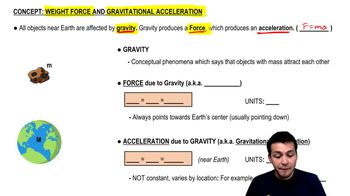
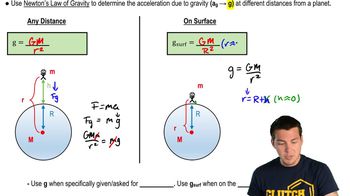
At the surface of Jupiter's moon Io, the acceleration due to gravity is m/s2. A watermelon weighs N at the surface of the earth. What is the watermelon's mass on the earth's surface?
3
views
1
rank

 Verified step by step guidance
 07:32
07:32
 05:20
05:20 06:54
06:54At the surface of Jupiter's moon Io, the acceleration due to gravity is m/s2. A watermelon weighs N at the surface of the earth. What is the watermelon's mass on the earth's surface?
A -kg experimental cart undergoes an acceleration in a straight line (the -axis). The graph in Fig. E shows this acceleration as a function of time. During what times is the net force on the cart a constant?
A small -kg rocket burns fuel that exerts a time-varying upward force on the rocket (assume constant mass) as the rocket moves upward from the launch pad. This force obeys the equation . Measurements show that at , the force is N, and at the end of the first s, it is N. Find the constants and , including their SI units.
A -kg experimental cart undergoes an acceleration in a straight line (the -axis). The graph in Fig. E shows this acceleration as a function of time. Find the maximum net force on this cart. When does this maximum force occur?
At the surface of Jupiter's moon Io, the acceleration due to gravity is m/s2. A watermelon weighs N at the surface of the earth. What would be its mass and weight on the surface of Io?
World-class sprinters can accelerate out of the starting blocks with an acceleration that is nearly horizontal and has magnitude m/s2. How much horizontal force must a -kg sprinter exert on the starting blocks to produce this acceleration? Which body exerts the force that propels the sprinter: the blocks or the sprinter herself?