
A box rests on a frozen pond, which serves as a frictionless horizontal surface. If a fisherman applies a horizontal force with magnitude N to the box and produces an acceleration of magnitude m/s2, what is the mass of the box?
A hockey puck with mass kg is at rest at the origin () on the horizontal, frictionless surface of the rink. At time a player applies a force of N to the puck, parallel to the -axis; she continues to apply this force until s. If the same force is again applied at s, what are the position and speed of the puck at s?
Verified step by step guidance
Verified video answer for a similar problem:
Key Concepts
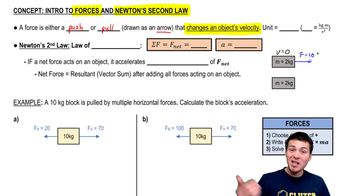
Newton's Second Law of Motion
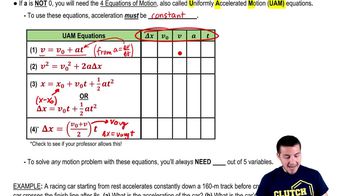
Kinematics Equations
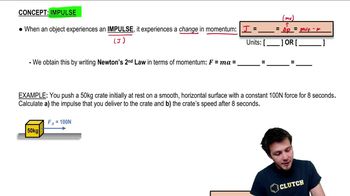
Impulse and Momentum
A -kg experimental cart undergoes an acceleration in a straight line (the -axis). The graph in Fig. E shows this acceleration as a function of time. During what times is the net force on the cart a constant?
A dockworker applies a constant horizontal force of N to a block of ice on a smooth horizontal floor. The frictional force is negligible. The block starts from rest and moves m in s. What is the mass of the block of ice?
A small -kg rocket burns fuel that exerts a time-varying upward force on the rocket (assume constant mass) as the rocket moves upward from the launch pad. This force obeys the equation . Measurements show that at , the force is N, and at the end of the first s, it is N. Find the constants and , including their SI units.
A -kg experimental cart undergoes an acceleration in a straight line (the -axis). The graph in Fig. E shows this acceleration as a function of time. Find the maximum net force on this cart. When does this maximum force occur?
A hockey puck with mass kg is at rest at the origin () on the horizontal, frictionless surface of the rink. At time a player applies a force of N to the puck, parallel to the -axis; she continues to apply this force until s. What are the position and speed of the puck at s?
