Ch 03: Motion in Two or Three Dimensions
Young & Freedman Calc - University Physics 15th Edition
Young & Freedman Calc15th EditionUniversity PhysicsISBN: 9780135159552Not the one you use?Change textbook
Chapter 3, Problem 4a

The position of a squirrel running in a park is given by r=[(0.280 m/s)t+(0.0360 m/s2)t2]i^+(0.0190 m/s3)t3j^\(\vec{r}\) = \(\left\)[ (0.280~\(\mathrm{m/s}\))t + (0.0360~\(\mathrm{m/s^2}\))t^2 \(\right\)] \(\hat{i}\) + (0.0190~\(\mathrm{m/s^3}\))t^3 \(\hat{j}\). (a) What are vx(t)v_{x}\(\left\)(t\(\right\)) and vy(t)v_{y}\(\left\)(t\(\right\)), the xx-and yy-components of the velocity of the squirrel, as functions of time?

Verified step by step guidance
1
To find the velocity components, we need to differentiate the position vector with respect to time. The position vector is given as r(t) = [(0.280 m/s)t + (0.0360 m/s^2)t^2]î + (0.0190 m/s^3)t^3ĵ.
The x-component of the position is x(t) = (0.280 m/s)t + (0.0360 m/s^2)t^2. To find the x-component of the velocity, differentiate x(t) with respect to time t: υx(t) = d/dt[(0.280 m/s)t + (0.0360 m/s^2)t^2].
Apply the power rule of differentiation: d/dt[at^n] = n*at^(n-1). For the term (0.280 m/s)t, the derivative is 0.280 m/s. For the term (0.0360 m/s^2)t^2, the derivative is 2*(0.0360 m/s^2)t = 0.0720 m/s^2 * t.
Thus, the x-component of the velocity is υx(t) = 0.280 m/s + 0.0720 m/s^2 * t.
Now, for the y-component of the position, y(t) = (0.0190 m/s^3)t^3. Differentiate y(t) with respect to time t to find the y-component of the velocity: υy(t) = d/dt[(0.0190 m/s^3)t^3]. Using the power rule, the derivative is 3*(0.0190 m/s^3)t^2 = 0.0570 m/s^3 * t^2. Therefore, the y-component of the velocity is υy(t) = 0.0570 m/s^3 * t^2.

Verified video answer for a similar problem:

This video solution was recommended by our tutors as helpful for the problem above.
Video duration:
2m
Was this helpful?

Key Concepts

Here are the essential concepts you must grasp in order to answer the question correctly.

Differentiation

Differentiation is a mathematical process used to find the rate at which a quantity changes. In physics, it is often used to determine velocity from a position function. By differentiating the position function with respect to time, we can find the velocity components, which are the derivatives of the position components.
Recommended video:
Guided course
13:04
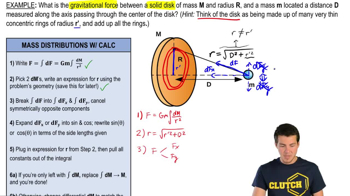
Gravitational Force from a Solid Disk

Vector Components

Vector components are the projections of a vector along the axes of a coordinate system. In this problem, the position vector r is expressed in terms of its x-component (î) and y-component (ĵ). Understanding how to separate these components is crucial for calculating the velocity in each direction independently.
Recommended video:
Guided course
07:30
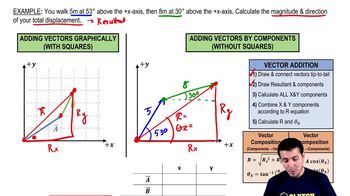
Vector Addition By Components

Polynomial Functions

Polynomial functions consist of terms with variables raised to integer powers. The position function given is a polynomial in terms of time, t, with coefficients indicating the rate of change. Recognizing the structure of polynomial functions helps in applying differentiation rules to find the velocity components as functions of time.
Recommended video:
Guided course
08:30
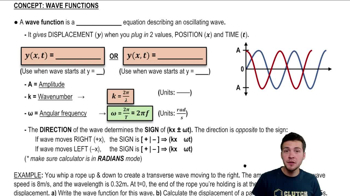
Intro to Wave Functions
Related Practice