
Ch 03: Motion in Two or Three Dimensions
Young & Freedman Calc - University Physics 15th Edition
Young & Freedman Calc15th EditionUniversity PhysicsISBN: 9780135159552Not the one you use?Change textbook
Chapter 3, Problem 16e

On level ground a shell is fired with an initial velocity of 40.0 m/s at 60.0° above the horizontal and feels no appreciable air resistance. At its highest point, find the horizontal and vertical components of its acceleration and velocity.

Verified step by step guidance
1
Start by understanding that the shell is subject to projectile motion, which involves both horizontal and vertical components of motion. The acceleration due to gravity acts vertically downward throughout the motion.
At the highest point of the projectile's trajectory, the vertical component of the velocity becomes zero because the shell momentarily stops moving upward before descending. The horizontal component of the velocity remains constant throughout the motion since there is no air resistance.
The horizontal component of the initial velocity can be calculated using the formula: vx=vcosθ, where v is the initial velocity and θ is the angle of projection.
The vertical component of the initial velocity can be calculated using the formula: vy=vsinθ. At the highest point, this component becomes zero.
The acceleration in the horizontal direction is zero because there is no air resistance or other forces acting horizontally. The vertical acceleration is equal to the acceleration due to gravity, which is g=9.8m/s2 downward.

Verified video answer for a similar problem:

This video solution was recommended by our tutors as helpful for the problem above.
Video duration:
7m
Was this helpful?

Key Concepts

Here are the essential concepts you must grasp in order to answer the question correctly.

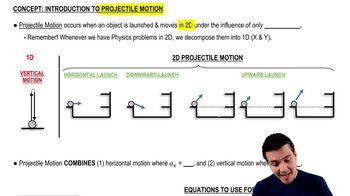
Projectile Motion

Projectile motion involves the motion of an object thrown into the air, subject to only the acceleration due to gravity. It can be analyzed by breaking it into horizontal and vertical components. The horizontal motion is uniform, while the vertical motion is uniformly accelerated due to gravity.
Recommended video:
Guided course
04:44
Introduction to Projectile Motion

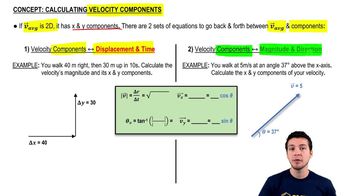
Components of Velocity

The velocity of a projectile can be split into horizontal and vertical components using trigonometric functions. At the highest point, the vertical component of velocity is zero, while the horizontal component remains constant, as there is no air resistance affecting the motion.
Recommended video:
Guided course
05:53
Calculating Velocity Components

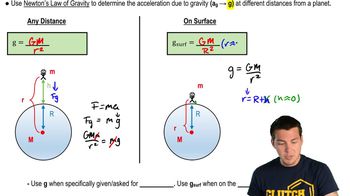
Acceleration Due to Gravity

In projectile motion, the only acceleration acting on the object is due to gravity, which is approximately 9.81 m/s² downward. At the highest point of the trajectory, the horizontal acceleration is zero, and the vertical acceleration is equal to the acceleration due to gravity.
Recommended video:
Guided course
05:20
Acceleration Due to Gravity
Related Practice
Textbook Question

In a carnival booth, you can win a stuffed giraffe if you toss a quarter into a small dish. The dish is on a shelf above the point where the quarter leaves your hand and is a horizontal distance of 2.1 m from this point (Fig. E3.19). If you toss the coin with a velocity of 6.4 m/s at an angle of 60° above the horizontal, the coin will land in the dish. Ignore air resistance. What is the height of the shelf above the point where the quarter leaves your hand?

3
views
Textbook Question

On level ground a shell is fired with an initial velocity of 40.0 m/s at 60.0° above the horizontal and feels no appreciable air resistance. How long does it take the shell to reach its highest point?

2
views
Textbook Question

A shot putter releases the shot some distance above the level ground with a velocity of 12.0 m/s, 51.0° above the horizontal. The shot hits the ground 2.08 s later. Ignore air resistance. How far did she throw the shot horizontally?

1
views
Textbook Question

On level ground a shell is fired with an initial velocity of 40.0 m/s at 60.0° above the horizontal and feels no appreciable air resistance. How far from its firing point does the shell land?

3
views
Textbook Question

A shot putter releases the shot some distance above the level ground with a velocity of 12.0 m/s, 51.0° above the horizontal. The shot hits the ground 2.08 s later. Ignore air resistance. What are the components of the shot's velocity at the beginning and at the end of its trajectory?

1
views
Textbook Question

On level ground a shell is fired with an initial velocity of 40.0 m/s at 60.0° above the horizontal and feels no appreciable air resistance. Find its maximum height above the ground.

2
views