
Ch 03: Motion in Two or Three Dimensions
Young & Freedman Calc - University Physics 15th Edition
Young & Freedman Calc15th EditionUniversity PhysicsISBN: 9780135159552Not the one you use?Change textbook
Chapter 3, Problem 41a

A river flows due south with a speed of 2.0 m/s. You steer a motorboat across the river; your velocity relative to the water is 4.2 m/s due east. The river is 500 m wide. What is your velocity (magnitude and direction) relative to the earth?

Verified step by step guidance
1
First, identify the components of the boat's velocity relative to the earth. The boat has a velocity of 4.2 m/s due east relative to the water and the river flows south at 2.0 m/s. These two velocities are perpendicular to each other, forming a right triangle.
Use the Pythagorean theorem to find the magnitude of the resultant velocity. The magnitude \( v \) of the velocity relative to the earth can be calculated using \( v = \sqrt{v_{east}^2 + v_{south}^2} \), where \( v_{east} = 4.2 \) m/s and \( v_{south} = 2.0 \) m/s.
Calculate the direction of the resultant velocity using trigonometry. The direction \( \theta \) can be found using the tangent function: \( \tan(\theta) = \frac{v_{south}}{v_{east}} \). Solve for \( \theta \) to find the angle south of east.
Now, consider the width of the river, which is 500 m. Calculate the time it takes to cross the river using the eastward component of the velocity: \( t = \frac{d}{v_{east}} \), where \( d = 500 \) m.
Finally, use the time calculated to determine how far downstream the boat will be when it reaches the opposite bank. Multiply the southward component of the velocity by the time: \( d_{downstream} = v_{south} \times t \).

Verified video answer for a similar problem:

This video solution was recommended by our tutors as helpful for the problem above.
Video duration:
4m
Was this helpful?

Key Concepts

Here are the essential concepts you must grasp in order to answer the question correctly.

Relative Velocity

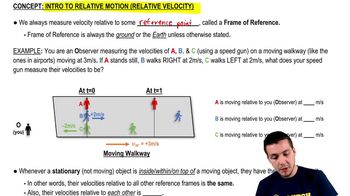
Relative velocity is the velocity of an object as observed from a particular reference frame. In this problem, the boat's velocity relative to the earth is determined by combining its velocity relative to the water and the river's velocity. This involves vector addition, where the boat's eastward velocity and the river's southward velocity are combined to find the resultant velocity.
Recommended video:
Guided course
04:27
Intro to Relative Motion (Relative Velocity)

Vector Addition

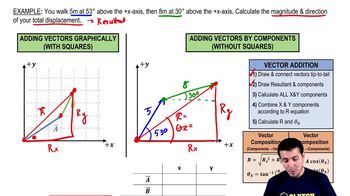
Vector addition is a method used to combine two or more vectors to find a resultant vector. It involves adding the components of the vectors along each axis. In this scenario, the boat's eastward velocity and the river's southward velocity are perpendicular, requiring the use of the Pythagorean theorem to find the magnitude of the resultant velocity and trigonometry to determine its direction.
Recommended video:
Guided course
07:30
Vector Addition By Components

Trigonometry in Physics

Trigonometry is used in physics to resolve vectors into components and to find angles between vectors. In this problem, trigonometric functions such as sine, cosine, or tangent can be used to determine the direction of the resultant velocity vector relative to the earth. The angle can be calculated using the inverse tangent function, considering the ratio of the river's velocity to the boat's velocity.
Recommended video:
Guided course
3:26
Trigonometry
Related Practice
Textbook Question

Two piers, A and B, are located on a river; B is 1500 m downstream from A (Fig. E3.32). Two friends must make round trips from pier A to pier B and return. One rows a boat at a constant speed of 4.00 km/h relative to the water; the other walks on the shore at a constant speed of 4.00 km/h. The velocity of the river is 2.80 km/h in the direction from A to B. How much time does it take each person to make the round trip?


4
views
Textbook Question

An airplane pilot wishes to fly due west. A wind of 80.0 km/h (about 50 mi/h) is blowing toward the south. What is the speed of the plane over the ground? Draw a vector diagram.

2
views
Textbook Question

An airplane pilot wishes to fly due west. A wind of 80.0 km/h (about 50 mi/h) is blowing toward the south. If the airspeed of the plane (its speed in still air) is 320.0 km/h (about 200 mi/h), in which direction should the pilot head?

2
views
Textbook Question

The nose of an ultralight plane is pointed due south, and its airspeed indicator shows 35 m/s35\(\text{ m/s}\). The plane is in a 10 m/s10\(\text{ m/s}\) wind blowing toward the southwest relative to the earth. Let xx be east and yy be north, and find the components of vP/E\(\overrightarrow{v}\)_{P/E} .

2
views
Textbook Question

A river flows due south with a speed of 2.0 m/s. You steer a motorboat across the river; your velocity relative to the water is 4.2 m/s due east. The river is 500 m wide. How much time is required to cross the river?

2
views
Textbook Question

The nose of an ultralight plane is pointed due south, and its airspeed indicator shows 35 m/s35\(\text{ m/s}\). The plane is in a 10 m/s10\(\text{ m/s}\) wind blowing toward the southwest relative to the earth. In a vector-addition diagram, show the relationship of vP/E\(\overrightarrow{v}\)_{P/E} (the velocity of the plane relative to the earth) to the two given vectors.

3
views