
Ch 03: Motion in Two or Three Dimensions
Young & Freedman Calc - University Physics 15th Edition
Young & Freedman Calc15th EditionUniversity PhysicsISBN: 9780135159552Not the one you use?Change textbook
Chapter 3, Problem 35a

A 'moving sidewalk' in an airport terminal moves at 1.0 m/s and is 35.0 m long. If a woman steps on at one end and walks at 1.5 m/s relative to the moving sidewalk, how much time does it take her to reach the opposite end if she walks in the same direction the sidewalk is moving?

Verified step by step guidance
1
First, understand the scenario: The woman is walking on a moving sidewalk. The sidewalk itself moves at a speed of 1.0 m/s, and she walks at a speed of 1.5 m/s relative to the sidewalk.
To find her total speed relative to the ground, add her walking speed to the speed of the sidewalk. This is because both speeds are in the same direction. So, her total speed is 1.0 m/s + 1.5 m/s.
Next, determine the total distance she needs to cover, which is the length of the sidewalk, given as 35.0 m.
Use the formula for time, which is \( t = \frac{d}{v} \), where \( d \) is the distance and \( v \) is the velocity. Substitute the values: \( d = 35.0 \) m and \( v \) is the total speed calculated in the previous step.
Calculate the time it takes for her to reach the opposite end using the formula. This will give you the time in seconds.

Verified video answer for a similar problem:

This video solution was recommended by our tutors as helpful for the problem above.
Video duration:
2m
Was this helpful?

Key Concepts

Here are the essential concepts you must grasp in order to answer the question correctly.

Relative Velocity

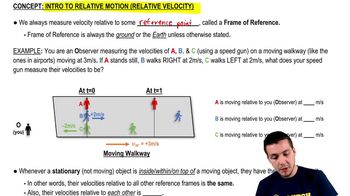
Relative velocity is the velocity of an object as observed from a particular reference frame, and it is crucial for understanding motion in different contexts. In this problem, the woman's walking speed relative to the moving sidewalk must be combined with the sidewalk's speed to find her total speed relative to the ground.
Recommended video:
Guided course
04:27
Intro to Relative Motion (Relative Velocity)

Addition of Velocities

The addition of velocities is a fundamental concept in physics where the velocities of two objects are combined to find the resultant velocity. Here, the woman's walking speed (1.5 m/s) is added to the sidewalk's speed (1.0 m/s) to determine her total speed relative to the ground, which is essential for calculating the time taken to cover the distance.
Recommended video:
Guided course
7:27
Escape Velocity

Time, Speed, and Distance Relationship

The relationship between time, speed, and distance is given by the formula: time = distance/speed. This formula is used to calculate the time it takes for the woman to travel the length of the sidewalk. By knowing the total speed and the distance, we can determine the time required to reach the opposite end.
Recommended video:
Guided course
06:24
Satellite Speed
Related Practice
Textbook Question

At its Ames Research Center, NASA uses its large '20-G' centrifuge to test the effects of very large accelerations ('hypergravity') on test pilots and astronauts. In this device, an arm 8.84 m long rotates about one end in a horizontal plane, and an astronaut is strapped in at the other end. Suppose that he is aligned along the centrifuge's arm with his head at the outermost end. The maximum sustained acceleration to which humans are subjected in this device is typically 12.5g. How fast must the astronaut's head be moving to experience this maximum acceleration?

1
views
Textbook Question

At its Ames Research Center, NASA uses its large '20-G' centrifuge to test the effects of very large accelerations ('hypergravity') on test pilots and astronauts. In this device, an arm 8.84 m long rotates about one end in a horizontal plane, and an astronaut is strapped in at the other end. Suppose that he is aligned along the centrifuge's arm with his head at the outermost end. The maximum sustained acceleration to which humans are subjected in this device is typically 12.5g. How fast in rpm (rev/min) is the arm turning to produce the maximum sustained acceleration?

1
views
Textbook Question

At its Ames Research Center, NASA uses its large '20-G' centrifuge to test the effects of very large accelerations ('hypergravity') on test pilots and astronauts. In this device, an arm 8.84 m long rotates about one end in a horizontal plane, and an astronaut is strapped in at the other end. Suppose that he is aligned along the centrifuge's arm with his head at the outermost end. The maximum sustained acceleration to which humans are subjected in this device is typically 12.5g. What is the difference between the acceleration of his head and feet if the astronaut is 2.00 m tall?

8
views
Textbook Question

A railroad flatcar is traveling to the right at a speed of 13.0 m/s relative to an observer standing on the ground. Someone is riding a motor scooter on the flatcar (Fig. E3.30). What is the velocity (magnitude and direction) of the scooter relative to the flatcar if the scooter's velocity relative to the observer on the ground is 18.0 m/s to the right?

3
views
Textbook Question

A 'moving sidewalk' in an airport terminal moves at 1.0 m/s and is 35.0 m long. If a woman steps on at one end and walks at 1.5 m/s relative to the moving sidewalk, how much time does it take her to reach the opposite end if she walks In the opposite direction?

3
views
Textbook Question

A canoe has a velocity of 0.40 m/s southeast relative to the earth. The canoe is on a river that is flowing 0.50 m/s east relative to the earth. Find the velocity (magnitude and direction) of the canoe relative to the river.

1
views