A rocket starts from rest and moves upward from the surface of the earth. For the first s of its motion, the vertical acceleration of the rocket is given by m/s3, where the -direction is upward. What is the height of the rocket above the surface of the earth at s?
Ch 02: Motion Along a Straight Line
Young & Freedman Calc15th EditionUniversity PhysicsISBN: 9780135159552Not the one you use?Change textbook
Chapter 2, Problem 62b
A small rocket burns 0.0500 kg of fuel per second, ejecting it as a gas with a velocity relative to the rocket of magnitude 1600 m/s. Would the rocket operate in outer space where there is no atmosphere? If so, how would you steer it? Could you brake it?
Verified step by step guidance1
The rocket operates based on the principle of conservation of momentum, specifically Newton's Third Law of Motion. When the rocket ejects fuel at high velocity, it generates an equal and opposite reaction force that propels the rocket forward. This principle works regardless of the presence of an atmosphere, so the rocket would indeed operate in outer space.
To steer the rocket in outer space, the rocket would need to use directional thrusters or gimbaled engines. By changing the direction of the ejected fuel (or using small side thrusters), the rocket can create torque, allowing it to rotate and change its orientation.
Braking the rocket in outer space is possible by firing the main engine or retro-thrusters in the direction opposite to the rocket's motion. This would reduce its velocity by applying a force in the opposite direction of travel.
The absence of an atmosphere in outer space means there is no air resistance to assist in braking or steering. All maneuvers must rely solely on the controlled ejection of fuel to generate the necessary forces.
In summary, the rocket can operate, steer, and brake in outer space by utilizing the controlled ejection of fuel, as the principles of conservation of momentum and Newton's laws are independent of the presence of an atmosphere.

Verified video answer for a similar problem:
This video solution was recommended by our tutors as helpful for the problem above.
Video duration:
1mWas this helpful?
Key Concepts
Here are the essential concepts you must grasp in order to answer the question correctly.
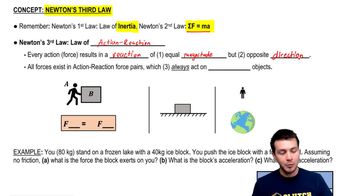
Newton's Third Law of Motion
Newton's Third Law states that for every action, there is an equal and opposite reaction. This principle is fundamental in understanding how rockets operate; as the rocket expels gas downwards, it experiences an upward thrust. This law explains why rockets can function in the vacuum of space, where there is no atmosphere.
Recommended video:
Guided course
Newton's Third Law & Action-Reaction Pairs
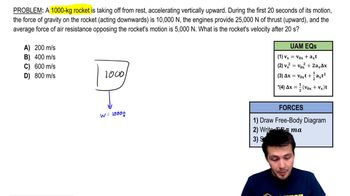
Rocket Propulsion
Rocket propulsion relies on the principle of conservation of momentum, where the mass of the expelled fuel and its velocity create thrust. The rocket's ability to burn fuel and eject it at high speeds allows it to accelerate in the absence of atmospheric pressure. This mechanism is crucial for maneuvering in space, as it enables the rocket to change velocity and direction.
Recommended video:
Guided course
Liftoff!
Steering and Braking in Space
In space, steering a rocket is achieved by adjusting the direction of the thrust produced by the engines or using reaction control systems (RCS) that expel small amounts of gas. Braking is accomplished by reversing the thrust direction or using retro-rockets to slow down. Both actions rely on the principles of momentum and thrust, allowing for precise control in a vacuum.
Recommended video:
Guided course
Entropy Increase When Braking
Related Practice
Textbook Question
4
views
Textbook Question
A rocket starts from rest and moves upward from the surface of the earth. For the first s of its motion, the vertical acceleration of the rocket is given by m/s3, where the -direction is upward. What is the speed of the rocket when it is m above the surface of the earth?
8
views
Textbook Question
You throw a small rock straight up from the edge of a highway bridge that crosses a river. The rock passes you on its way down, s after it was thrown. What is the speed of the rock just before it reaches the water m below the point where the rock left your hand? Ignore air resistance.
1
views
