
Textbook Question
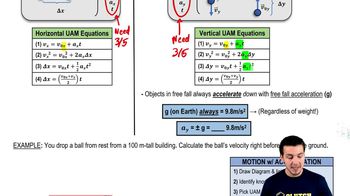
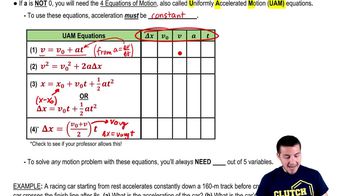
A brick is dropped (zero initial speed) from the roof of a building. The brick strikes the ground in s. You may ignore air resistance, so the brick is in free fall. How tall, in meters, is the building?
1
views


 Verified step by step guidance
 08:36
08:36
 08:25
08:25 7:27
7:27A brick is dropped (zero initial speed) from the roof of a building. The brick strikes the ground in s. You may ignore air resistance, so the brick is in free fall. How tall, in meters, is the building?
A -kg rocket blasts off vertically from the launch pad with a constant upward acceleration of m/s2 and feels no appreciable air resistance. When it has reached a height of m, its engines suddenly fail; the only force acting on it is now gravity. What is the maximum height this rocket will reach above the launch pad?
A hot-air balloonist, rising vertically with a constant velocity of magnitude m/s, releases a sandbag at an instant when the balloon is m above the ground (Fig. E). After the sandbag is released, it is in free fall. Compute the position and velocity of the sandbag at s and s after its release.
A -kg rocket blasts off vertically from the launch pad with a constant upward acceleration of m/s2 and feels no appreciable air resistance. When it has reached a height of m, its engines suddenly fail; the only force acting on it is now gravity. How much time will elapse after engine failure before the rocket comes crashing down to the launch pad, and how fast will it be moving just before it crashes?
A brick is dropped (zero initial speed) from the roof of a building. The brick strikes the ground in s. You may ignore air resistance, so the brick is in free fall. What is the magnitude of the brick's velocity just before it reaches the ground?
A tennis ball on Mars, where the acceleration due to gravity is and air resistance is negligible, is hit directly upward and returns to the same level s later. How fast was it moving just after it was hit?