Textbook Question
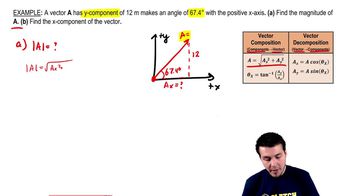
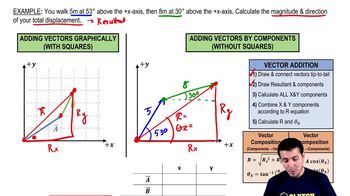
You are given two vectors A = -3i + 6j and B = 7i + 2j. Let Counterclockwise angles be positive. What angle does A make with the +x-axis?

 Young & Freedman Calc 15th EditionCh 01: Units, Physical Quantities & VectorsProblem 36a
 Verified step by step guidance
 03:59
03:59
 07:30
07:30 13:46
13:46You are given two vectors A = -3i + 6j and B = 7i + 2j. Let Counterclockwise angles be positive. What angle does A make with the +x-axis?
In each case, find the x- and y- components of vector A: A = 11.2j - 9.91i
Vector A is 2.80 cm long and is 60.0° above the x-axis in the first quadrant. Vector B is 1.90 cm long and is 60.0° below the x-axis in the fourth quadrant (Fig. E1.35). Use components to find the magnitude and direction of A - B In each case, sketch the vector addition or subtraction and show that your numerical answers are in qualitative agreement with your sketch.
A disoriented physics professor drives 3.25 km north, then 2.20 km west, and then 1.50 km south. Find the magnitude and direction of the resultant displacement, using the method of components. In a vector-addition diagram (roughly to scale), show that the resultant displacement found from your diagram is in qualitative agreement with the result you obtained by using the method of components.
Given two vectors A = -2i + 3j + 4k and B = 3.00î + 1.00ĵ − 3.00k, find the magnitude of each vector.
Find the scalar product of the vectors A and B given in Exercise 1.38.