Ch 44: Particle Physics and Cosmology
Young & Freedman Calc - University Physics 14th Edition
Young & Freedman Calc14th EditionUniversity PhysicsISBN: 9780321973610Not the one you use?Change textbook
Chapter 44, Problem 8a

An electron with a total energy of 30.030.0 GeV collides with a stationary positron. What is the available energy?

Verified step by step guidance
1
Step 1: Understand the concept of available energy in particle collisions. The available energy is the total energy that can be converted into mass or other forms of energy in the center-of-mass frame of the system. For collisions involving a stationary particle, the available energy depends on the total energy of the moving particle and the rest energy of both particles.
Step 2: Recall the rest energy formula for a particle, which is given by \( E_{rest} = m c^2 \), where \( m \) is the mass of the particle and \( c \) is the speed of light. For an electron and positron, their rest energy is identical because they have the same mass.
Step 3: Use the formula for available energy in the center-of-mass frame for a collision between a moving particle and a stationary particle: \( E_{available} = \sqrt{2 E_{moving} E_{rest} + (E_{rest})^2} \). Here, \( E_{moving} \) is the total energy of the moving electron, and \( E_{rest} \) is the rest energy of the positron.
Step 4: Substitute the given values into the formula. The total energy of the moving electron is \( E_{moving} = 30.0 \, \text{GeV} \), and the rest energy of the positron is \( E_{rest} = 0.511 \, \text{MeV} \), which needs to be converted to GeV (\( 1 \text{GeV} = 1000 \text{MeV} \)).
Step 5: Perform the calculation step-by-step to find \( E_{available} \). First, convert \( E_{rest} \) to GeV, then compute \( 2 E_{moving} E_{rest} \), add \( (E_{rest})^2 \), and finally take the square root to determine the available energy.

Verified video answer for a similar problem:

This video solution was recommended by our tutors as helpful for the problem above.
Video duration:
1m
Was this helpful?

Key Concepts

Here are the essential concepts you must grasp in order to answer the question correctly.

Total Energy in Particle Physics

Total energy in particle physics includes both the rest mass energy and the kinetic energy of a particle. For an electron, this is calculated using Einstein's equation E=mc², where m is the rest mass. In high-energy collisions, the kinetic energy becomes significant, and the total energy is the sum of the rest mass energy and the kinetic energy.
Recommended video:
Guided course
04:54
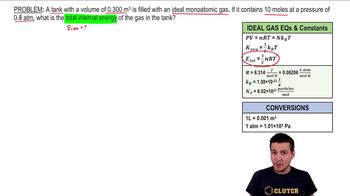
Total Internal Energy

Center of Mass Energy

The available energy in a collision is often referred to as the center of mass energy, which is the energy available for particle interactions. It is calculated by considering the energies of both colliding particles in their center of mass frame. For a stationary positron, the available energy is the total energy of the moving electron plus the rest mass energy of the positron.
Recommended video:
Guided course
06:30
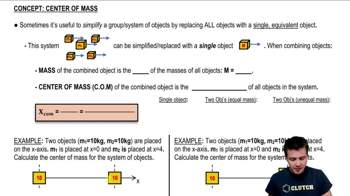
Intro to Center of Mass

Rest Mass Energy

Rest mass energy is the energy equivalent of a particle's mass when it is at rest, given by E=mc². For an electron and positron, their rest mass energies contribute to the total energy available in a collision. In this scenario, the rest mass energy of the positron must be added to the total energy of the electron to determine the total available energy for the interaction.
Recommended video:
Guided course
8:39
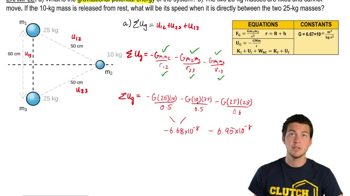
Energy Conservation in Three-Mass System