Ch 44: Particle Physics and Cosmology
Young & Freedman Calc - University Physics 14th Edition
Young & Freedman Calc14th EditionUniversity PhysicsISBN: 9780321973610Not the one you use?Change textbook
Chapter 44, Problem 1

A neutral pion at rest decays into two photons. Find the energy, frequency, and wavelength of each photon. In which part of the electromagnetic spectrum does each photon lie? (Use the pion mass given in terms of the electron mass in Section 44.144.1.)

Verified step by step guidance
1
Step 1: Begin by understanding the decay process. A neutral pion at rest decays into two photons. Since the pion is initially at rest, its total energy is equal to its rest energy, which is given by Einstein's equation: Epion = mpionc2. The energy of the pion is distributed equally between the two photons due to conservation of energy and momentum.
Step 2: Use the mass of the pion provided in Section 44.1, expressed in terms of the electron mass. The mass of the pion is approximately mpion ≈ 273 melectron. Multiply this by the electron mass (melectron ≈ 9.11 × 10⁻³¹ kg) and substitute into the rest energy formula to find the total energy of the pion.
Step 3: Divide the total energy of the pion equally between the two photons. Since the pion is at rest, the photons are emitted in opposite directions with equal energy. The energy of each photon is therefore: Ephoton = Epion/2.
Step 4: Relate the energy of each photon to its frequency using Planck's equation: Ephoton = hν, where h is Planck's constant (h ≈ 6.63 × 10⁻³⁴ J·s) and ν is the frequency of the photon. Solve for ν using the energy calculated in Step 3.
Step 5: Calculate the wavelength of each photon using the relationship between frequency and wavelength: λ = c/ν, where c is the speed of light (c ≈ 3.00 × 10⁸ m/s). Finally, identify the part of the electromagnetic spectrum to which the photons belong based on their calculated wavelength.

Verified video answer for a similar problem:

This video solution was recommended by our tutors as helpful for the problem above.
Video duration:
3m
Was this helpful?

Key Concepts

Here are the essential concepts you must grasp in order to answer the question correctly.

Energy-Mass Equivalence

Energy-mass equivalence, described by Einstein's equation E=mc², states that mass can be converted into energy and vice versa. In the context of particle decay, the rest mass of the neutral pion is converted into the energy of the resulting photons. This principle is crucial for calculating the energy of the photons produced in the decay process.
Recommended video:
Guided course
4:52
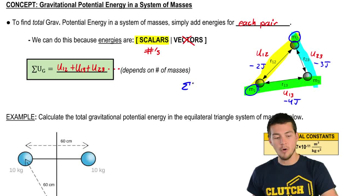
Gravitational Potential Energy for Systems of Masses

Photon Properties

Photons are massless particles that carry electromagnetic radiation. Each photon has energy (E), frequency (f), and wavelength (λ) related by the equations E=hf and c=fλ, where h is Planck's constant and c is the speed of light. Understanding these relationships is essential for determining the energy, frequency, and wavelength of the photons resulting from the pion decay.
Recommended video:
Guided course
08:45
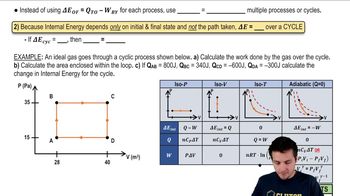
Properties of Cyclic Thermodynamic Processes

Electromagnetic Spectrum

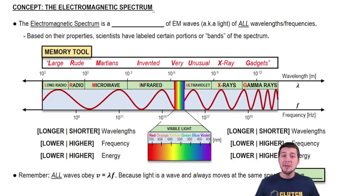
The electromagnetic spectrum encompasses all types of electromagnetic radiation, ranging from radio waves to gamma rays. Each type of radiation is characterized by its wavelength and frequency. Identifying the part of the spectrum where the photons lie requires calculating their wavelengths and comparing them to known ranges, which helps in understanding their physical properties and applications.
Recommended video:
Guided course
06:06
The Electromagnetic Spectrum