Ch 41: Quantum Mechanics II: Atomic Structure
Young & Freedman Calc - University Physics 14th Edition
Young & Freedman Calc14th EditionUniversity PhysicsISBN: 9780321973610Not the one you use?Change textbook
Chapter 41, Problem 9

The orbital angular momentum of an electron has a magnitude of 4.716×10344.716\(\times\)10^{-34} kg-m2/s. What is the angular momentum quantum number ll for this electron?

Verified step by step guidance
1
Understand the relationship between the orbital angular momentum and the angular momentum quantum number. The magnitude of the orbital angular momentum (L) is given by the formula: L = √(l(l+1))ℏ, where l is the angular momentum quantum number and is the reduced Planck's constant (ℏ = 1.055 × 10^{-34} \(\text{ J·s}\)).
Rearrange the formula to solve for l. Start by isolating √(l(l+1)): √(l(l+1)) = rac{L}{ℏ}.
Substitute the given value of L = 4.716 × 10^{-34} \(\text{ kg·m}\)^2/\(\text{s}\) and ℏ = 1.055 × 10^{-34} \(\text{ J·s}\) into the equation: √(l(l+1)) = rac{4.716 × 10^{-34}}{1.055 × 10^{-34}}.
Simplify the right-hand side to find the numerical value of √(l(l+1)). Then square both sides of the equation to eliminate the square root, resulting in l(l+1) = (\(\text{calculated value}\))^2.
Solve the quadratic equation l^2 + l - (\(\text{calculated value}\))^2 = 0 to find the angular momentum quantum number l. Since l must be a non-negative integer, select the appropriate solution.

Verified video answer for a similar problem:

This video solution was recommended by our tutors as helpful for the problem above.
Video duration:
4m
Was this helpful?

Key Concepts

Here are the essential concepts you must grasp in order to answer the question correctly.

Orbital Angular Momentum

Orbital angular momentum is a measure of the rotational motion of an electron around the nucleus of an atom. It is quantized and can be expressed in terms of the angular momentum quantum number (l), where the magnitude of the angular momentum is given by the formula L = √(l(l+1))ħ, with ħ being the reduced Planck's constant.
Recommended video:
Guided course
06:18
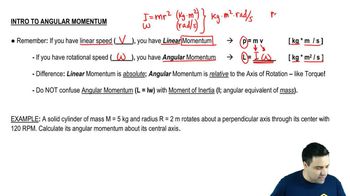
Intro to Angular Momentum

Angular Momentum Quantum Number (l)

The angular momentum quantum number (l) determines the shape of an electron's orbital and can take on integer values from 0 to n-1, where n is the principal quantum number. Each value of l corresponds to a specific type of orbital (s, p, d, f), influencing the electron's energy and spatial distribution.
Recommended video:
Guided course
12:12
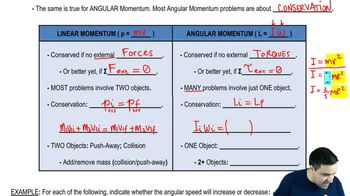
Conservation of Angular Momentum

Planck's Constant

Planck's constant (ħ) is a fundamental constant in quantum mechanics that relates the energy of a photon to its frequency. It plays a crucial role in quantization, allowing the calculation of angular momentum and other properties of particles at the quantum level. Its value is approximately 1.055 x 10^-34 J·s.
Recommended video:
Guided course
08:59
Phase Constant of a Wave Function
Related Practice
Textbook Question

Consider an electron in the NN shell. What is the largest orbital angular momentum this electron could have in any chosen direction? Express your answers in terms of \(\hslash\) and in SI units.

1
views
Textbook Question

Consider an electron in the NN shell. What is the largest spin angular momentum this electron could have in any chosen direction? Express your answers in terms of \(\hslash\) and in SI units.

1
views
Textbook Question

In a particular state of the hydrogen atom, the angle between the angular momentum vector L\(\overrightarrow{L}\) and the zz-axis is u=26.6u = 26.6°. If this is the smallest angle for this particular value of the orbital quantum number ll, what is ll?

1
views
Textbook Question

Consider an electron in the NN shell. For the electron in part (c), what is the ratio of its spin angular momentum in the zz-direction to its orbital angular momentum in the zz-direction? Note: Part (c) asked for the largest orbital angular momentum this electron could have in any chosen direction.

2
views
Textbook Question

Calculate, in units of UU, the magnitude of the maximum orbital angular momentum for an electron in a hydrogen atom for states with a principal quantum number of 22, 2020, and 200200. Compare each with the value of nhnh postulated in the Bohr model. What trend do you see?

1
views
Textbook Question

A hydrogen atom is in a dd state. In the absence of an external magnetic field, the states with different mlm_l values have (approximately) the same energy. Consider the interaction of the magnetic field with the atom's orbital magnetic dipole moment. Calculate the splitting (in electron volts) of the ml levels when the atom is put in a 0.8000.800 T magnetic field that is in the +z+z-direction

1
views