Ch 41: Quantum Mechanics II: Atomic Structure
Young & Freedman Calc - University Physics 14th Edition
Young & Freedman Calc14th EditionUniversity PhysicsISBN: 9780321973610Not the one you use?Change textbook
Chapter 41, Problem 33b

Estimate the energy of the least strongly bound level in the LL shell of N2+.

Verified step by step guidance
1
Step 1: Understand the problem. The question asks for the energy of the least strongly bound level in the L shell of N2+. This involves calculating the binding energy of an electron in the L shell of a nitrogen ion with a charge of +2.
Step 2: Recall the formula for the energy levels of a hydrogen-like ion: \( E_n = - \frac{Z^2 \cdot R_H}{n^2} \), where \( Z \) is the atomic number, \( R_H \) is the Rydberg constant, and \( n \) is the principal quantum number. For the L shell, \( n = 2 \).
Step 3: Determine the effective nuclear charge \( Z_{eff} \). For N2+, the atomic number \( Z \) of nitrogen is 7, but since two electrons have been removed, the effective nuclear charge experienced by the remaining electrons will be higher due to reduced electron shielding.
Step 4: Substitute \( Z_{eff} \), \( R_H \), and \( n = 2 \) into the formula \( E_n = - \frac{Z_{eff}^2 \cdot R_H}{n^2} \). This will give the energy of the least strongly bound level in the L shell.
Step 5: Interpret the result. The negative sign in the energy indicates that the electron is bound to the nucleus. The magnitude of the energy represents how strongly the electron is bound, with smaller absolute values corresponding to less strongly bound levels.

Verified video answer for a similar problem:

This video solution was recommended by our tutors as helpful for the problem above.
Video duration:
2m
Was this helpful?

Key Concepts

Here are the essential concepts you must grasp in order to answer the question correctly.

Binding Energy

Binding energy is the energy required to remove an electron from an atom or ion. In the context of atomic physics, it indicates how strongly an electron is held by the nucleus. The least strongly bound level corresponds to the electron that is easiest to remove, which is crucial for understanding ionization processes and energy levels in multi-electron systems.
Recommended video:
Guided course
04:10
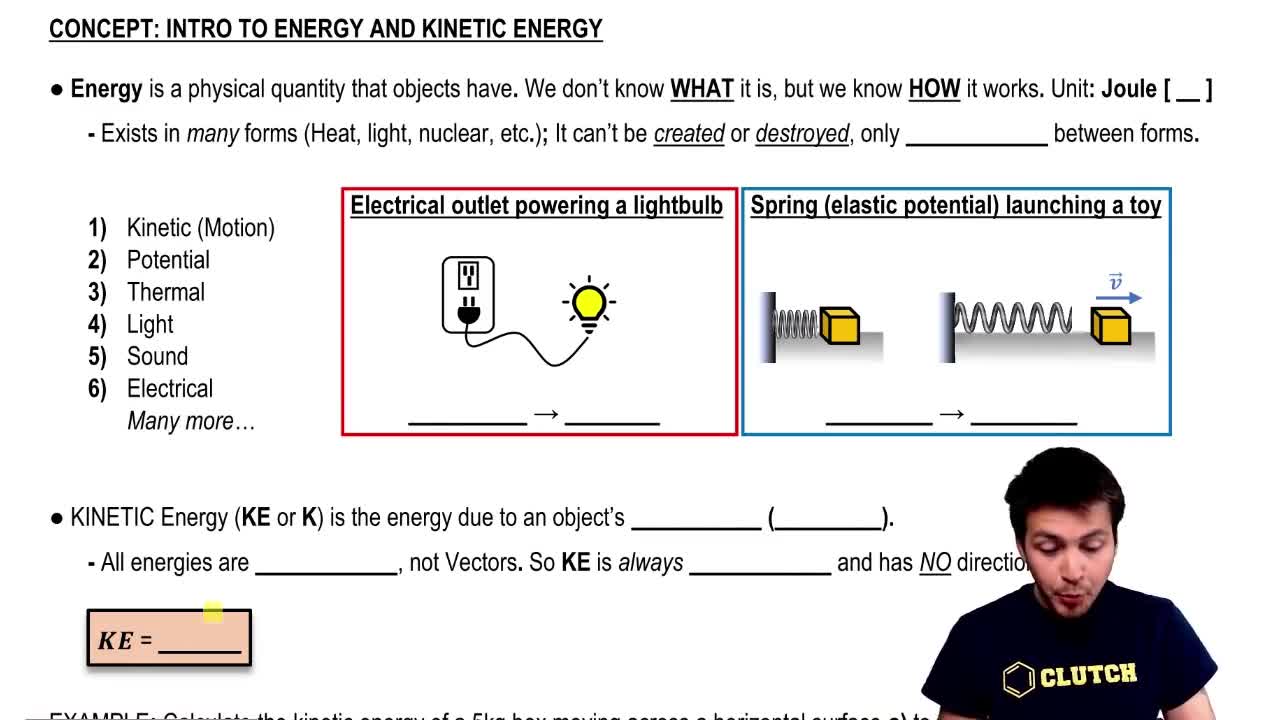
Intro to Energy & Types of Energy

Quantum Levels

Quantum levels, or energy levels, refer to the discrete energy states that electrons can occupy in an atom. Each level is associated with a specific quantum number and can hold a limited number of electrons. For nitrogen ions like N2+, the L shell corresponds to the second energy level, which is important for determining the energy of electrons in that shell.
Recommended video:
Guided course
04:25
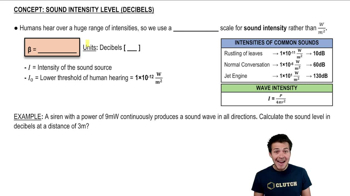
Sound Intensity Level and the Decibel Scale

Ionization Energy

Ionization energy is the amount of energy needed to remove an electron from an atom or ion in its gaseous state. It is a critical concept in understanding the stability of electrons in various shells and how they interact with external energy sources. For N2+, estimating the energy of the least strongly bound level involves calculating the ionization energy for the L shell electrons.
Recommended video:
Guided course
04:10
Intro to Energy & Types of Energy