
Ch 40: Quantum Mechanics I: Wave Functions
Young & Freedman Calc - University Physics 14th Edition
Young & Freedman Calc14th EditionUniversity PhysicsISBN: 9780321973610Not the one you use?Change textbook
Chapter 40, Problem 1

An electron is moving as a free particle in the x-x-direction with momentum that has magnitude 4.50×10244.50\(\times\)10^{-24} kg-m/s. What is the one-­dimensional time-­dependent wave function of the electron?

Verified step by step guidance
1
Understand the problem: The question asks for the one-dimensional time-dependent wave function of an electron moving as a free particle. The wave function for a free particle is generally expressed as a plane wave, which depends on the particle's momentum and energy.
Recall the general form of the time-dependent wave function for a free particle: \( \psi(x, t) = A e^{i(kx - \omega t)} \), where \( A \) is the amplitude, \( k \) is the wave number, and \( \omega \) is the angular frequency. These quantities are related to the particle's momentum and energy.
Determine the wave number \( k \): The wave number is related to the momentum \( p \) by the equation \( k = \frac{p}{\hbar} \), where \( \hbar \) is the reduced Planck's constant (\( \hbar = 1.0545718 \times 10^{-34} \, \text{J·s} \)). Substitute the given momentum \( p = 4.50 \times 10^{-24} \, \text{kg·m/s} \) into this equation to find \( k \).
Determine the angular frequency \( \omega \): The angular frequency is related to the energy \( E \) of the particle by \( \omega = \frac{E}{\hbar} \). For a free particle, the energy is given by \( E = \frac{p^2}{2m} \), where \( m \) is the mass of the electron (\( m = 9.10938356 \times 10^{-31} \, \text{kg} \)). Use the given momentum to calculate \( E \), and then substitute into \( \omega = \frac{E}{\hbar} \).
Write the final wave function: Substitute the values of \( k \) and \( \omega \) into the general form \( \psi(x, t) = A e^{i(kx - \omega t)} \). Since the electron is moving in the -x-direction, the wave function will have a negative sign in front of \( kx \), resulting in \( \psi(x, t) = A e^{i(-kx - \omega t)} \).

Verified video answer for a similar problem:

This video solution was recommended by our tutors as helpful for the problem above.
Was this helpful?

Key Concepts

Here are the essential concepts you must grasp in order to answer the question correctly.

Wave Function

In quantum mechanics, the wave function is a mathematical description of the quantum state of a particle. It contains all the information about the particle's position, momentum, and other physical properties. The wave function is typically denoted by the Greek letter psi (Ψ) and is a complex-valued function of position and time, which can be used to calculate probabilities of finding the particle in various states.
Recommended video:
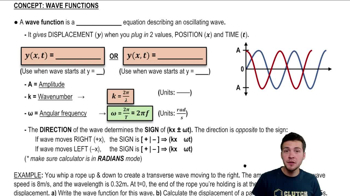
Guided course
08:30
Intro to Wave Functions

Momentum and Wave-Particle Duality

Momentum is a fundamental property of moving objects, defined as the product of mass and velocity. In quantum mechanics, particles like electrons exhibit wave-particle duality, meaning they can behave both as particles and as waves. The momentum of a particle is related to its wave properties through the de Broglie wavelength, which connects the particle's momentum to the wavelength of its associated wave function.
Recommended video:
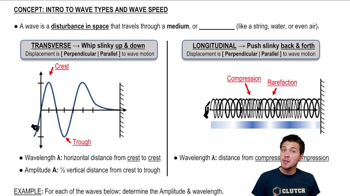
Guided course
07:19
Intro to Waves and Wave Speed

Time-Dependent Schrödinger Equation

The time-dependent Schrödinger equation is a key equation in quantum mechanics that describes how the wave function of a quantum system evolves over time. It incorporates both the kinetic and potential energy of the system and is essential for predicting the behavior of particles. Solving this equation allows us to determine the time-dependent wave function of a particle, which is crucial for understanding its dynamics.
Recommended video:
09:03
Mirror Equation