Ch 39: Particles Behaving as Waves
Young & Freedman Calc - University Physics 14th Edition
Young & Freedman Calc14th EditionUniversity PhysicsISBN: 9780321973610Not the one you use?Change textbook
Chapter 39, Problem 9

Calculate the de Broglie wavelength of a 5.005.00-g bullet that is moving at 340340 m/s. Will the bullet exhibit wavelike properties?

Verified step by step guidance
1
Step 1: Recall the de Broglie wavelength formula: λ = hp, where λ is the wavelength, h is Planck's constant (6.626 *⁢ 10-34 J⋅s), and p is the momentum of the object.
Step 2: Calculate the momentum p of the bullet using the formula p = mv, where m is the mass of the bullet (5.00 g = 0.00500 kg) and v is its velocity (340 m/s).
Step 3: Substitute the calculated momentum p into the de Broglie wavelength formula: λ = hp. This will give the de Broglie wavelength of the bullet.
Step 4: Compare the calculated wavelength to the typical size of objects or wavelengths in the macroscopic world. If the wavelength is extremely small (on the order of 10-34 m or smaller), the bullet will not exhibit noticeable wavelike properties.
Step 5: Conclude whether the bullet exhibits wavelike properties based on the comparison in Step 4. Typically, macroscopic objects like bullets have de Broglie wavelengths that are too small to observe wavelike behavior.

Verified video answer for a similar problem:

This video solution was recommended by our tutors as helpful for the problem above.
Video duration:
3m
Was this helpful?

Key Concepts

Here are the essential concepts you must grasp in order to answer the question correctly.

de Broglie Wavelength

The de Broglie wavelength is a fundamental concept in quantum mechanics that relates the wavelength of a particle to its momentum. It is given by the formula λ = h/p, where λ is the wavelength, h is Planck's constant (6.626 x 10^-34 Js), and p is the momentum of the particle. For a moving object, momentum is calculated as the product of its mass and velocity (p = mv). This concept illustrates the wave-particle duality of matter.
Recommended video:
Guided course
05:42
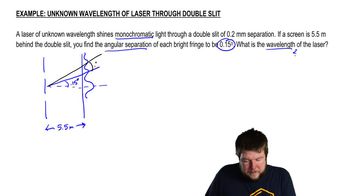
Unknown Wavelength of Laser through Double Slit

Wave-Particle Duality

Wave-particle duality is a principle in quantum mechanics that posits that every particle or quantum entity exhibits both wave-like and particle-like properties. This means that particles such as electrons and even larger objects can show interference and diffraction patterns, which are characteristic of waves. Understanding this duality is crucial for analyzing phenomena at the quantum level, including the behavior of macroscopic objects like bullets under certain conditions.
Recommended video:
Guided course
07:19
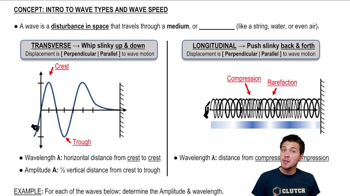
Intro to Waves and Wave Speed

Quantum Effects in Macroscopic Objects

Quantum effects typically dominate at the atomic and subatomic levels, but they become negligible for larger, macroscopic objects. In the case of a 5.00-g bullet, its mass and velocity result in a de Broglie wavelength that is exceedingly small, making any wavelike properties imperceptible. This concept helps to explain why everyday objects do not exhibit noticeable quantum behavior, as their wavelengths are far too small to influence their classical motion.
Recommended video:
08:17
Microscopic View of Current
Related Practice
Textbook Question

Through what potential difference must electrons be accelerated if they are to have:

(a) the same wavelength as an x ray of wavelength 0.2200.220 nm; and

(b) the same energy as the x ray in part (a)?

1
views
Textbook Question

An electron has a de Broglie wavelength of 2.80×10102.80\(\times\)10^{-10} m. Determine (a) the magnitude of its momentum and (b) its kinetic energy (in joules and in electron volts).

1
views
Textbook Question

A beam of alpha particles is incident on a target of lead. A particular alpha particle comes in 'head-on' to a particular lead nucleus and stops 6.50×10146.50\(\times\)10^{-14} m away from the center of the nucleus. (This point is well outside the nucleus.) Assume that the lead nucleus, which has 8282 protons, remains at rest. The mass of the alpha particle is 6.64×10276.64\(\times\)10^{-27} kg.

(a) Calculate the electrostatic potential energy at the instant that the alpha particle stops. Express your result in joules and in MeV.

(b) What initial kinetic energy (in joules and in MeV) did the alpha particle have?

(c) What was the initial speed of the alpha particle?

1
views
Textbook Question

A 4.784.78-MeV alpha particle from a 226226Ra decay makes a head-on collision with a uranium nucleus. A uranium nucleus has 9292 protons.

(a) What is the distance of closest approach of the alpha particle to the center of the nucleus? Assume that the uranium nucleus remains at rest and that the distance of closest approach is much greater than the radius of the uranium nucleus.

(b) What is the force on the alpha particle at the instant when it is at the distance of closest approach?

1
views
Textbook Question

An alpha particle (m=6.64×1027m=6.64\(\times\)10^{-27} kg) emitted in the radioactive decay of uranium-238238 has an energy of 4.204.20 MeV. What is its de Broglie wavelength?

1
views
Textbook Question

An electron is moving with a speed of 8.00×1068.00\(\times\)10^6 m/s. What is the speed of a proton that has the same de Broglie wavelength as this electron?

1
views