
A scientist has devised a new method of isolating individual particles. He claims that this method enables him to detect simultaneously the position of a particle along an axis with a standard deviation of nm and its momentum component along this axis with a standard deviation of kg-m/s. Use the Heisenberg uncertainty principle to evaluate the validity of this claim.
Ch 39: Particles Behaving as Waves
Young & Freedman Calc14th EditionUniversity PhysicsISBN: 9780321973610Not the one you use?Change textbook
Chapter 39, Problem 48
(a) The -coordinate of an electron is measured with an uncertainty of mm. What is the x-component of the electron's velocity, , if the minimum percent uncertainty in a simultaneous measurement of is ?
(b) Repeat part (a) for a proton.
Verified step by step guidance1
Step 1: Understand the problem and identify the relevant principle. This problem involves the Heisenberg Uncertainty Principle, which states that the product of the uncertainties in position (Δx) and momentum (Δp) is at least as large as ℏ/2, where ℏ is the reduced Planck constant. The relationship is given by: . Momentum is related to velocity via , where m is the mass of the particle.
Step 2: Convert the uncertainty in position (Δx) into SI units. The given uncertainty in the x-coordinate is 0.30 mm, which can be converted to meters: .
Step 3: Use the Heisenberg Uncertainty Principle to find the uncertainty in momentum (Δp). Rearrange the formula to solve for . Substitute the known values: ℏ = 1.054 × 10⁻³⁴ J·s and .
Step 4: Relate the uncertainty in momentum to the uncertainty in velocity. Using , solve for . For part (a), use the mass of the electron (m = 9.11 × 10⁻³¹ kg). For part (b), use the mass of the proton (m = 1.67 × 10⁻²⁷ kg).
Step 5: Calculate the minimum percent uncertainty in velocity. The problem states that the minimum percent uncertainty in velocity is 1.0%. Use this information to find the x-component of the electron's velocity, , by rearranging the formula for percent uncertainty: . Repeat the same process for the proton in part (b).

Verified video answer for a similar problem:
This video solution was recommended by our tutors as helpful for the problem above.
Video duration:
9mWas this helpful?
Key Concepts
Here are the essential concepts you must grasp in order to answer the question correctly.
Uncertainty Principle
The Uncertainty Principle, formulated by Werner Heisenberg, states that certain pairs of physical properties, like position and momentum, cannot be simultaneously measured with arbitrary precision. This principle implies that the more accurately we know one property (e.g., position), the less accurately we can know the other (e.g., momentum or velocity). In this context, the uncertainty in the electron's position affects the uncertainty in its velocity.
Recommended video:
Guided course
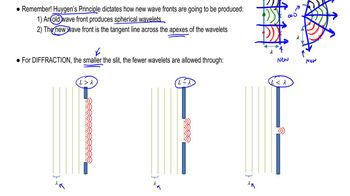
Diffraction with Huygen's Principle
Percent Uncertainty
Percent uncertainty is a way to express the uncertainty of a measurement relative to the size of the measurement itself. It is calculated by dividing the absolute uncertainty by the measured value and multiplying by 100. In the given question, a percent uncertainty of 1.0% for the electron's velocity indicates that the uncertainty in the velocity measurement is 1.0% of the actual velocity value, which is crucial for determining the velocity's precision.
Recommended video:
Guided course
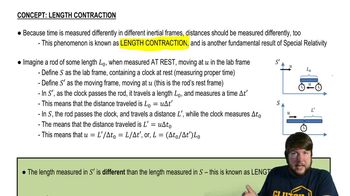
Length Contraction
Velocity and Kinematics
Velocity is a vector quantity that describes the rate of change of an object's position with respect to time. In kinematics, it is essential to understand how to relate position, velocity, and time, especially when considering uncertainties. The relationship between position and velocity can be expressed through the equation v = Δx/Δt, where Δx is the change in position and Δt is the change in time, allowing for calculations involving uncertainties in both position and velocity.
Recommended video:
Guided course
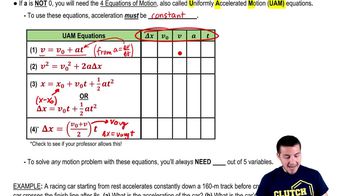
Kinematics Equations
Related Practice
Textbook Question
2
views
Textbook Question
The uncertainty in the y-component of a proton's position is m. What is the minimum uncertainty in a simultaneous measurement of the -component of the proton's velocity?
1
views
Textbook Question
-g marble is gently placed on a horizontal tabletop that is m wide.
(a) What is the maximum uncertainty in the horizontal position of the marble?
(b) According to the Heisenberg uncertainty principle, what is the minimum uncertainty in the horizontal velocity of the marble?
(c) In light of your answer to part (b), what is the longest time the marble could remain on the table? Compare this time to the age of the universe, which is approximately billion years. (Hint: Can you know that the horizontal velocity of the marble is exactly zero?)
