Ch 39: Particles Behaving as Waves
Young & Freedman Calc - University Physics 14th Edition
Young & Freedman Calc14th EditionUniversity PhysicsISBN: 9780321973610Not the one you use?Change textbook
Chapter 39, Problem 44

A pesky 1.51.5-mg mosquito is annoying you as you attempt to study physics in your room, which is 5.05.0 m wide and 2.52.5 m high. You decide to swat the bothersome insect as it flies toward you, but you need to estimate its speed to make a successful hit.
(a) What is the maximum uncertainty in the horizontal position of the mosquito?
(b) What limit does the Heisenberg uncertainty principle place on your ability to know the horizontal velocity of this mosquito? Is this limitation a serious impediment to your attempt to swat it?

Verified step by step guidance
1
Step 1: Understand the problem and identify the key concepts. This problem involves the Heisenberg Uncertainty Principle, which states that the uncertainty in position (Δx) and the uncertainty in momentum (Δp) are related by the inequality Δx * Δp ≥ ℏ / 2, where ℏ is the reduced Planck's constant (ℏ ≈ 1.055 × 10⁻³⁴ J·s). Momentum is related to velocity by p = m * v, where m is the mass and v is the velocity.
Step 2: Calculate the maximum uncertainty in the horizontal position of the mosquito. Since the mosquito is flying in a room that is 5.0 m wide, the maximum uncertainty in its horizontal position (Δx) can be taken as the width of the room, Δx = 5.0 m.
Step 3: Use the Heisenberg Uncertainty Principle to find the minimum uncertainty in the horizontal momentum (Δp). Rearrange the inequality to solve for Δp: Δp ≥ ℏ / (2 * Δx). Substitute the known values of ℏ and Δx into this equation to calculate Δp.
Step 4: Relate the uncertainty in momentum (Δp) to the uncertainty in velocity (Δv). Since momentum is given by p = m * v, the uncertainty in velocity can be expressed as Δv = Δp / m. Use the mosquito's mass (m = 1.5 mg = 1.5 × 10⁻⁶ kg) and the previously calculated Δp to find Δv.
Step 5: Analyze whether the uncertainty in velocity (Δv) is significant. Compare the calculated Δv to the typical speed of a mosquito (which is on the order of 1 m/s). If Δv is much smaller than the mosquito's speed, the uncertainty is negligible, and the Heisenberg Uncertainty Principle does not pose a serious impediment to swatting the mosquito.

Verified video answer for a similar problem:

This video solution was recommended by our tutors as helpful for the problem above.
Video duration:
7m
Was this helpful?

Key Concepts

Here are the essential concepts you must grasp in order to answer the question correctly.

Heisenberg Uncertainty Principle

The Heisenberg Uncertainty Principle states that it is impossible to simultaneously know both the exact position and exact momentum (or velocity) of a particle. This principle highlights a fundamental limit in quantum mechanics, where the more precisely one property is known, the less precisely the other can be known. For small particles like a mosquito, this principle becomes significant when estimating their position and velocity.
Recommended video:
Guided course
14:47
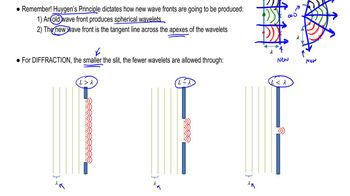
Diffraction with Huygen's Principle

Momentum

Momentum is a vector quantity defined as the product of an object's mass and its velocity. In physics, momentum is crucial because it is conserved in isolated systems, meaning the total momentum before and after an event remains constant. Understanding momentum helps in analyzing the motion of objects, including the mosquito in this scenario, and is essential for calculating its velocity.
Recommended video:
Guided course
05:17
Intro to Momentum

Measurement Uncertainty

Measurement uncertainty refers to the doubt that exists about the result of any measurement. In the context of the mosquito's position and velocity, it quantifies the limits of precision in determining these values. This uncertainty can arise from various factors, including the limitations of measuring instruments and the inherent variability in the system being measured, which is particularly relevant when applying the Heisenberg Uncertainty Principle.
Recommended video:
Guided course
07:49
Proper Frames and Measurements
Related Practice
Textbook Question

Two stars, both of which behave like ideal blackbodies, radiate the same total energy per second. The cooler one has a surface temperature TT and a diameter 3.03.0 times that of the hotter star.

(a) What is the temperature of the hotter star in terms of TT?

(b) What is the ratio of the peak-intensity wavelength of the hot star to the peak-intensity wavelength of the cool star?

1
views
Textbook Question

Photorefractive keratectomy (PRK) is a laser-based surgical procedure that corrects near- and farsightedness by removing part of the lens of the eye to change its curvature and hence focal length. This procedure can remove layers 0.250.25 mm thick using pulses lasting 12.012.0 ns from a laser beam of wavelength 193193 nm. Low-intensity beams can be used because each individual photon has enough energy to break the covalent bonds of the tissue. If a 1.501.50-mW beam is used, how many photons are delivered to the lens in each pulse?

Textbook Question

A scientist has devised a new method of isolating individual particles. He claims that this method enables him to detect simultaneously the position of a particle along an axis with a standard deviation of 0.120.12 nm and its momentum component along this axis with a standard deviation of 3.0×10253.0\(\times\)10^{-25} kg-m/s. Use the Heisenberg uncertainty principle to evaluate the validity of this claim.

2
views
Textbook Question

The uncertainty in the y-component of a proton's position is 2.0×10122.0\(\times\)10^{-12} m. What is the minimum uncertainty in a simultaneous measurement of the yy-component of the proton's velocity?

1
views
Textbook Question

10.010.0-g marble is gently placed on a horizontal tabletop that is 1.751.75 m wide.

(a) What is the maximum uncertainty in the horizontal position of the marble?

(b) According to the Heisenberg uncertainty principle, what is the minimum uncertainty in the horizontal velocity of the marble?

(c) In light of your answer to part (b), what is the longest time the marble could remain on the table? Compare this time to the age of the universe, which is approximately 1414 billion years. (Hint: Can you know that the horizontal velocity of the marble is exactly zero?)

Textbook Question

The shortest visible wavelength is about 400400 nm. What is the temperature of an ideal radiator whose spectral emittance peaks at this wavelength?

1
views