Ch 38: Photons: Light Waves Behaving as Particles
Young & Freedman Calc - University Physics 14th Edition
Young & Freedman Calc14th EditionUniversity PhysicsISBN: 9780321973610Not the one you use?Change textbook
Chapter 38, Problem 4a

A laser used to weld detached retinas emits light with a wavelength of 652652 nm in pulses that are 20.020.0 ms in duration. The average power during each pulse is 0.6000.600 W. How much energy is in each pulse in joules? In electron volts?

Verified step by step guidance
1
Step 1: Understand the relationship between power, energy, and time. The energy in each pulse can be calculated using the formula \( E = P \cdot t \), where \( E \) is energy, \( P \) is power, and \( t \) is the duration of the pulse.
Step 2: Convert the given duration of the pulse from milliseconds to seconds. Since \( 1 \, \text{ms} = 10^{-3} \, \text{s} \), the duration \( t \) is \( 20.0 \, \text{ms} = 20.0 \cdot 10^{-3} \, \text{s} \).
Step 3: Substitute the given values for power \( P = 0.600 \, \text{W} \) and duration \( t = 20.0 \cdot 10^{-3} \, \text{s} \) into the formula \( E = P \cdot t \) to calculate the energy in joules.
Step 4: Convert the energy from joules to electron volts. Use the conversion factor \( 1 \, \text{eV} = 1.602 \cdot 10^{-19} \, \text{J} \). Divide the energy in joules by \( 1.602 \cdot 10^{-19} \) to find the energy in electron volts.
Step 5: Summarize the results: The energy in each pulse is expressed in both joules and electron volts, providing a clear understanding of the energy emitted by the laser during each pulse.

Verified video answer for a similar problem:

This video solution was recommended by our tutors as helpful for the problem above.
Video duration:
3m
Was this helpful?

Key Concepts

Here are the essential concepts you must grasp in order to answer the question correctly.

Energy and Power Relationship

Energy is defined as the capacity to do work, and power is the rate at which energy is transferred or converted. The relationship between energy (E), power (P), and time (t) can be expressed as E = P × t. In this context, the energy in each pulse of the laser can be calculated by multiplying the average power of the laser by the duration of the pulse.
Recommended video:
Guided course
03:43
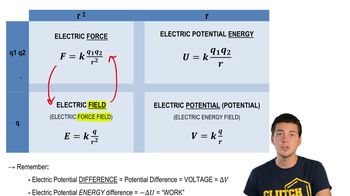
Relationships Between Force, Field, Energy, Potential

Wavelength and Energy of Photons

The energy of a photon is inversely related to its wavelength, described by the equation E = hc/λ, where h is Planck's constant and c is the speed of light. This relationship indicates that shorter wavelengths correspond to higher energy photons. For the laser light with a wavelength of 652 nm, this concept is essential for converting the energy calculated in joules to electron volts, a common unit for photon energy.
Recommended video:
Guided course
05:42
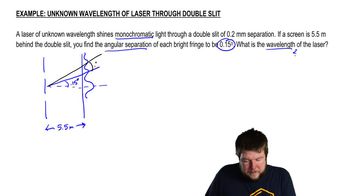
Unknown Wavelength of Laser through Double Slit

Conversion between Joules and Electron Volts

An electron volt (eV) is a unit of energy defined as the amount of kinetic energy gained by a single electron when accelerated through an electric potential difference of one volt. The conversion factor between joules and electron volts is 1 eV = 1.602 × 10^-19 joules. Understanding this conversion is crucial for expressing the energy of the laser pulse in both joules and electron volts, allowing for a comprehensive analysis of the laser's energy output.
Recommended video:
Guided course
07:46
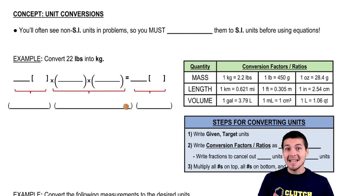
Unit Conversions