Ch 38: Photons: Light Waves Behaving as Particles
Young & Freedman Calc - University Physics 14th Edition
Young & Freedman Calc14th EditionUniversity PhysicsISBN: 9780321973610Not the one you use?Change textbook
Chapter 38, Problem 24

A horizontal beam of laser light of wavelength 585585 nm passes through a narrow slit that has width 0.06200.0620 mm. The intensity of the light is measured on a vertical screen that is 2.002.00 m from the slit.
(a) What is the minimum uncertainty in the vertical component of the momentum of each photon in the beam after the photon has passed through the slit?
(b) Use the result of part (a) to estimate the width of the central diffraction maximum that is observed on the screen.

Verified step by step guidance
1
Step 1: Understand the problem and identify the key concepts. This problem involves the uncertainty principle and diffraction. Part (a) requires using the Heisenberg uncertainty principle to find the minimum uncertainty in the vertical component of the momentum of photons. Part (b) involves estimating the width of the central diffraction maximum using the result from part (a) and the geometry of the setup.
Step 2: Apply the Heisenberg uncertainty principle for part (a). The uncertainty principle states that Δy * Δp_y ≥ ℏ/2, where Δy is the uncertainty in position (slit width) and Δp_y is the uncertainty in the vertical component of momentum. Here, Δy = 0.0620 mm = 6.20 × 10⁻⁵ m. Solve for Δp_y: Δp_y = ℏ / (2 * Δy), where ℏ is the reduced Planck's constant (ℏ ≈ 1.055 × 10⁻³⁴ J·s).
Step 3: Relate the uncertainty in momentum to the angular spread of the photons for part (b). The vertical component of momentum is related to the angle θ of diffraction by p_y = p * sin(θ), where p is the total momentum of a photon. The total momentum of a photon is given by p = h / λ, where h is Planck's constant (h ≈ 6.626 × 10⁻³⁴ J·s) and λ is the wavelength of the light (λ = 585 nm = 5.85 × 10⁻⁷ m). Use Δp_y to estimate the angular spread Δθ: Δθ ≈ Δp_y / p.
Step 4: Estimate the width of the central diffraction maximum on the screen. The width of the central maximum is approximately 2 * y, where y is the distance from the center of the screen to the first minimum. The position of the first minimum in single-slit diffraction is given by y = L * tan(θ), where L is the distance to the screen (L = 2.00 m) and θ is the angular spread. For small angles, tan(θ) ≈ sin(θ) ≈ θ, so y ≈ L * Δθ.
Step 5: Combine the results to find the width of the central maximum. Using the relationship from step 4, the width of the central maximum is approximately 2 * y = 2 * L * Δθ. Substitute the values of L and Δθ from the previous steps to estimate the width. This completes the solution process.

Verified video answer for a similar problem:

This video solution was recommended by our tutors as helpful for the problem above.
Video duration:
7m
Was this helpful?

Key Concepts

Here are the essential concepts you must grasp in order to answer the question correctly.

Uncertainty Principle

The Heisenberg Uncertainty Principle states that it is impossible to simultaneously know both the position and momentum of a particle with absolute precision. In the context of photons passing through a slit, the narrower the slit, the greater the uncertainty in the vertical momentum of the photons. This principle is crucial for calculating the minimum uncertainty in momentum as it relates to the width of the slit.
Recommended video:
Guided course
14:47
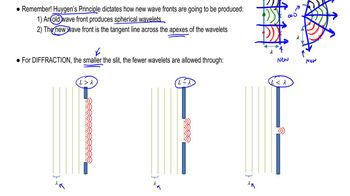
Diffraction with Huygen's Principle

Diffraction

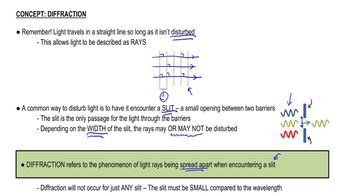
Diffraction is the bending of waves around obstacles and the spreading of waves when they pass through narrow openings. In this scenario, the laser light passing through the slit creates a diffraction pattern on the screen, characterized by a central maximum and several side maxima. Understanding diffraction is essential for estimating the width of the central maximum observed on the screen.
Recommended video:

Photon Momentum

Photons, despite being massless, carry momentum, which can be calculated using the formula p = h/λ, where p is momentum, h is Planck's constant, and λ is the wavelength of the light. This concept is vital for determining the momentum of the photons after they pass through the slit, as it directly relates to the uncertainty in their vertical component of momentum and the resulting diffraction pattern.
Recommended video:
Guided course
05:17
Intro to Momentum