
Why Are We Bombarded by Muons? Muons are unstable subatomic particles that decay to electrons with a mean lifetime of 2.2 μs. They are produced when cosmic rays bombard the upper atmosphere about 10 km above the earth's surface, and they travel very close to the speed of light. The problem we want to address is why we see any of them at the earth's surface. (a) What is the greatest distance a muon could travel during its 2.2 μs lifetime? (b) According to your answer in part (a), it would seem that muons could never make it to the ground. But the 2.2 μs lifetime is measured in the frame of the muon, and muons are moving very fast. At a speed of 0.999c, what is the mean lifetime of a muon as measured by an observer at rest on the earth? How far would the muon travel in this time? Does this result explain why we find muons in cosmic rays? (c) From the point of view of the muon, it still lives for only 2.2 μs, so how does it make it to the ground? What is the thickness of the 10 km of atmosphere through which the muon must travel, as measured by the muon? Is it now clear how the muon is able to reach the ground?

- Ch 01: Units, Physical Quantities & Vectors41
- Ch 02: Motion Along a Straight Line67
- Ch 03: Motion in Two or Three Dimensions47
- Ch 04: Newton's Laws of Motion23
- Ch 05: Applying Newton's Laws59
- Ch 06: Work & Kinetic Energy14
- Ch 07: Potential Energy & Conservation8
- Ch 08: Momentum, Impulse, and Collisions18
- Ch 09: Rotation of Rigid Bodies42
- Ch 10: Dynamics of Rotational Motion48
- Ch 11: Equilibrium & Elasticity27
- Ch 12: Fluid Mechanics31
- Ch 13: Gravitation35
- Ch 14: Periodic Motion32
- Ch 15: Mechanical Waves25
- Ch 16: Sound & Hearing32
- Ch 17: Temperature and Heat36
- Ch 18: Thermal Properties of Matter38
- Ch 19: The First Law of Thermodynamics33
- Ch 20: The Second Law of Thermodynamics22
- Ch 21: Electric Charge and Electric Field36
- Ch 22: Gauss' Law24
- Ch 23: Electric Potential31
- Ch 24: Capacitance and Dielectrics18
- Ch 25: Current, Resistance, and EMF26
- Ch 26: Direct-Current Circuits30
- Ch 27: Magnetic Field and Magnetic Forces18
- Ch 28: Sources of Magnetic Field10
- Ch 29: Electromagnetic Induction28
- Ch 30: Inductance17
- Ch 31: Alternating Current21
- Ch 32: Electromagnetic Waves1
- Ch 33: The Nature and Propagation of Light20
- Ch 34: Geometric Optics34
- Ch 35: Interference19
- Ch 36: Diffraction25
- Ch 37: Special Relativity20
- Ch 38: Photons: Light Waves Behaving as Particles15
- Ch 39: Particles Behaving as Waves26
- Ch 40: Quantum Mechanics I: Wave Functions21
- Ch 41: Quantum Mechanics II: Atomic Structure25
- Ch 42: Molecules and Condensed Matter18
- Ch 43: Nuclear Physics16
- Ch 44: Particle Physics and Cosmology23
As you pilot your space utility vehicle at a constant speed toward the moon, a race pilot flies past you in her spaceracer at a constant speed of relative to you. At the instant the spaceracer passes you, both of you start timers at zero.
(a) At the instant when you measure that the spaceracer has traveled m past you, what does the race pilot read on her timer?
(b) When the race pilot reads the value calculated in part (a) on her timer, what does she measure to be your distance from her?
(c) At the instant when the race pilot reads the value calculated in part (a) on her timer, what do you read on yours?
 Verified step by step guidance
Verified video answer for a similar problem:

Key Concepts
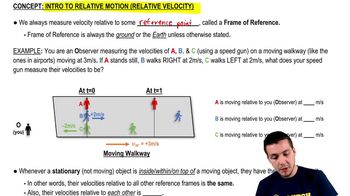
Relativity of Simultaneity
 04:27
04:27
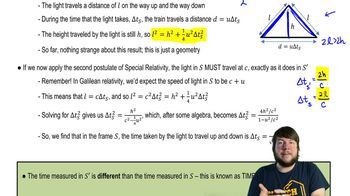
Time Dilation
 12:57
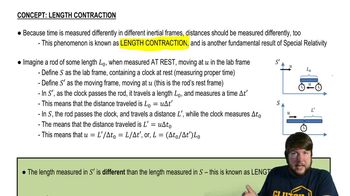
12:57Length Contraction
 07:02
07:02An unstable particle is created in the upper atmosphere from a cosmic ray and travels straight down toward the surface of the earth with a speed of 0.99540c relative to the earth. A scientist at rest on the earth’s surface measures that the particle is created at an altitude of 45.0 km. (a) As measured by the scientist, how much time does it take the particle to travel the 45.0 km to the surface of the earth? (b) Use the length-contraction formula to calculate the distance from where the particle is created to the surface of the earth as measured in the particle’s frame. (c) In the particle’s frame, how much time does it take the particle to travel from where it is created to the surface of the earth? Calculate this time both by the time dilation formula and from the distance calculated in part (b). Do the two results agree?
Suppose the two lightning bolts shown in Fig. 37.5a are simultaneous to an observer on the train. Show that they are not simultaneous to an observer on the ground. Which lightning strike does the ground observer measure to come first?
An alien spacecraft is flying overhead at a great distance as you stand in your backyard. You see its searchlight blink on for s. The first officer on the spacecraft measures that the searchlight is on for ms.
(a) Which of these two measured times is the proper time?
(b) What is the speed of the spacecraft relative to the earth, expressed as a fraction of the speed of light ?
The positive muon (µ+), an unstable particle, lives on average 2.20 × 10⁻⁶ s (measured in its own frame of reference) before decaying. If such a particle is moving, with respect to the laboratory, with a speed of 0.900c, what average lifetime is measured in the laboratory?
The positive muon (µ+), an unstable particle, lives on average 2.20 × 10⁻⁶ s (measured in its own frame of reference) before decaying. What average distance, measured in the laboratory, does the particle move before decaying?