

Ch 35: Interference
Young & Freedman Calc - University Physics 14th Edition
Young & Freedman Calc14th EditionUniversity PhysicsISBN: 9780321973610Not the one you use?Change textbook
Chapter 35, Problem 35

What is the thinnest soap film (excluding the case of zero thickness) that appears black when illuminated with light with wavelength 480 nm? The index of refraction of the film is 1.33, and there is air on both sides of the film.

Verified step by step guidance
1
Identify the condition for destructive interference in the soap film, which occurs when the path difference between the light waves reflected from the top and bottom surfaces of the film leads to a phase difference of an odd multiple of \(\pi\). The general condition for destructive interference in thin films is given by \(2nt = m\lambda/n\), where \(n\) is the index of refraction of the film, \(t\) is the thickness of the film, \(\lambda\) is the wavelength of light in vacuum, and \(m\) is an odd integer (1, 3, 5, ...).
Since we are looking for the thinnest film that appears black, we use the smallest odd integer for \(m\), which is 1. This simplifies the condition to \(2nt = \lambda/n\).
Substitute the given values into the equation. The index of refraction \(n = 1.33\) and the wavelength of light \(\lambda = 480\) nm.
Solve the equation \(2nt = \lambda/n\) for \(t\) to find the minimum thickness of the film. Rearrange the equation to \(t = \lambda/(2n^2)\).
Calculate the value of \(t\) using the values of \(\lambda\) and \(n\) to find the thinnest film thickness that results in a black appearance due to destructive interference.

Verified video answer for a similar problem:

This video solution was recommended by our tutors as helpful for the problem above.
Was this helpful?

Key Concepts

Here are the essential concepts you must grasp in order to answer the question correctly.

Interference of Light

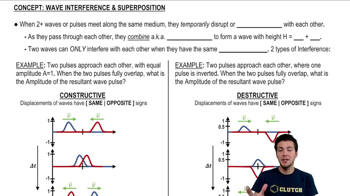
Interference occurs when two or more light waves overlap, resulting in a new wave pattern. In the context of thin films, constructive and destructive interference can happen depending on the film's thickness and the wavelength of light. For a soap film, specific thicknesses will cause certain wavelengths to be amplified or canceled out, leading to the observed colors.
Recommended video:
Guided course
03:47
Wave Interference & Superposition

Thin Film Equation

The thin film equation relates the thickness of a film to the wavelength of light and the refractive indices of the film and surrounding media. For a soap film with air on both sides, the condition for destructive interference (which can lead to a black appearance) is given by 2nt = (m + 0.5)λ, where n is the refractive index, t is the thickness, λ is the wavelength, and m is an integer.
Recommended video:
07:58
Thin Lens Equation

Refractive Index

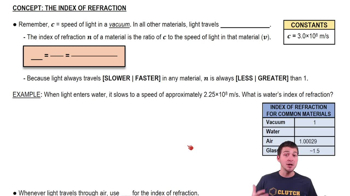
The refractive index is a measure of how much light slows down when passing through a medium compared to its speed in a vacuum. For the soap film, with a refractive index of 1.33, this value affects how light interacts with the film, influencing the conditions for interference. The refractive index is crucial for determining the effective wavelength of light within the film, which is necessary for applying the thin film equation.
Recommended video:
Guided course
03:46
Index of Refraction