
Ch 36: Diffraction
Young & Freedman Calc - University Physics 14th Edition
Young & Freedman Calc14th EditionUniversity PhysicsISBN: 9780321973610Not the one you use?Change textbook
Chapter 36, Problem 2

Parallel rays of green mercury light with a wavelength of 546 nm pass through a slit covering a lens with a focal length of 60.0 cm. In the focal plane of the lens, the distance from the central maximum to the first minimum is 8.65 mm. What is the width of the slit?

Verified step by step guidance
1
The problem involves single-slit diffraction, where the angular position of the first minimum is determined by the condition: a sin(θ) = mλ, where a is the slit width, λ is the wavelength of light, m is the order of the minimum (for the first minimum, m = 1), and θ is the diffraction angle.
The small-angle approximation can be applied here because the distance to the screen (focal length of the lens) is much larger than the distance from the central maximum to the first minimum. Using this approximation, sin(θ) ≈ tan(θ) ≈ y / f, where y is the distance from the central maximum to the first minimum (8.65 mm) and f is the focal length of the lens (60.0 cm).
Substitute sin(θ) into the diffraction condition: a (y / f) = λ. Rearrange this equation to solve for the slit width a: a = λ f / y.
Convert all quantities to consistent units before substituting into the formula. The wavelength λ is given as 546 nm, which should be converted to meters: λ = 546 × 10-9 m. The focal length f is 60.0 cm, which should be converted to meters: f = 0.600 m. The distance y is 8.65 mm, which should be converted to meters: y = 0.00865 m.
Substitute the converted values of λ, f, and y into the formula a = λ f / y to calculate the slit width a. This will give the final result for the width of the slit.

Verified video answer for a similar problem:

This video solution was recommended by our tutors as helpful for the problem above.
Video duration:
4m
Was this helpful?

Key Concepts

Here are the essential concepts you must grasp in order to answer the question correctly.

Diffraction

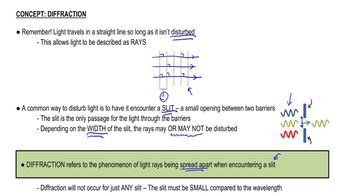
Diffraction is the bending of waves around obstacles and the spreading of waves when they pass through narrow openings. In the context of light passing through a slit, diffraction patterns are formed, characterized by alternating bright and dark regions. The width of the slit influences the extent of diffraction, with narrower slits causing more pronounced spreading of the light waves.
Recommended video:

Single-Slit Diffraction Formula

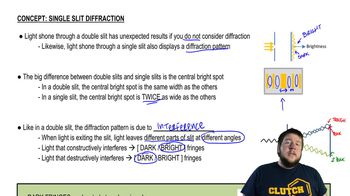
The single-slit diffraction pattern can be quantitatively described using the formula for the position of minima: a sin(θ) = mλ, where 'a' is the slit width, 'θ' is the angle of the minima, 'm' is the order of the minimum, and 'λ' is the wavelength of the light. This relationship allows us to calculate the slit width when the positions of the minima are known, as in the given problem.
Recommended video:
Guided course
12:33
Single Slit Diffraciton

Focal Length and Lens Behavior

The focal length of a lens is the distance from the lens to the point where parallel rays of light converge. In this scenario, the lens focuses the diffracted light from the slit, creating a pattern in the focal plane. Understanding how the focal length relates to the geometry of the setup is crucial for determining the positions of the diffraction minima and ultimately calculating the slit width.
Recommended video:
05:38
Lens Maker Equation
Related Practice
Textbook Question

Diffraction occurs for all types of waves, including sound waves. High-frequency sound from a distant source with wavelength 9.00 cm passes through a slit 12.0 cm wide. A microphone is placed 8.00 m directly in front of the center of the slit, corresponding to point O in Fig. 36.5a . The microphone is then moved in a direction perpendicular to the line from the center of the slit to point O. At what distances from O will the intensity detected by the microphone be zero?

1
views
Textbook Question

A series of parallel linear water wave fronts are traveling directly toward the shore at 15.0 cm/s on an otherwise placid lake. A long concrete barrier that runs parallel to the shore at a distance of 3.20 m away has a hole in it. You count the wave crests and observe that 75.0 of them pass by each minute, and you also observe that no waves reach the shore at ±61.3 cm from the point directly opposite the hole, but waves do reach the shore everywhere within this distance. How wide is the hole in the barrier?

4
views
Textbook Question

Light of wavelength 585 nm falls on a slit 0.0666 mm wide. (a) On a very large and distant screen, how many totally dark fringes (indicating complete cancellation) will there be, including both sides of the central bright spot? Solve this problem without calculating all the angles! (Hint: What is the largest that sin u can be? What does this tell you is the largest that m can be?) (b) At what angle will the dark fringe that is most distant from the central bright fringe occur?