
Ch 36: Diffraction
Young & Freedman Calc - University Physics 14th Edition
Young & Freedman Calc14th EditionUniversity PhysicsISBN: 9780321973610Not the one you use?Change textbook
Chapter 36, Problem 15a

A slit 0.240 mm wide is illuminated by parallel light rays of wavelength 540 nm. The diffraction pattern is observed on a screen that is 3.00 m from the slit. The intensity at the center of the central maximum (θ = 0°) is 6.00 x 10⁻⁶ W/m2. What is the distance on the screen from the center of the central maximum to the first minimum?

Verified step by step guidance
1
Step 1: Understand the problem. This is a single-slit diffraction problem where we need to calculate the distance from the center of the central maximum to the first minimum on the screen. The first minimum occurs when the path difference between light rays from the edges of the slit satisfies the condition: a * sin(θ) = m * λ, where 'a' is the slit width, 'λ' is the wavelength of light, and 'm' is the order of the minimum (m = 1 for the first minimum).
Step 2: Use the small-angle approximation. Since the screen is far from the slit (3.00 m), the angle θ is small, and we can approximate sin(θ) ≈ tan(θ) ≈ y/L, where 'y' is the distance from the central maximum to the first minimum on the screen, and 'L' is the distance from the slit to the screen. Substituting this into the condition for the first minimum gives: a * (y/L) = λ.
Step 3: Rearrange the equation to solve for 'y'. From the equation a * (y/L) = λ, we can isolate 'y' as: y = (λ * L) / a. Here, 'λ' is the wavelength of light (540 nm = 540 x 10^-9 m), 'L' is the distance to the screen (3.00 m), and 'a' is the slit width (0.240 mm = 0.240 x 10^-3 m).
Step 4: Substitute the known values into the equation. Replace 'λ', 'L', and 'a' with their respective values to calculate 'y'. Ensure all units are consistent (meters) before performing the calculation.
Step 5: Interpret the result. The value of 'y' obtained from the calculation represents the distance on the screen from the center of the central maximum to the first minimum. This distance is a direct consequence of the diffraction pattern created by the single slit.

Verified video answer for a similar problem:

This video solution was recommended by our tutors as helpful for the problem above.
Video duration:
6m
Was this helpful?

Key Concepts

Here are the essential concepts you must grasp in order to answer the question correctly.

Diffraction

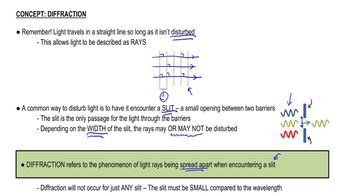
Diffraction is the bending of waves around obstacles and the spreading of waves when they pass through narrow openings. In the context of light, diffraction patterns arise when light encounters a slit, leading to regions of constructive and destructive interference. The width of the slit and the wavelength of the light significantly influence the diffraction pattern observed on a screen.
Recommended video:

Minima in Diffraction Patterns

In a single-slit diffraction pattern, minima occur at specific angles where destructive interference takes place. The position of the first minimum can be calculated using the formula a sin(θ) = mλ, where 'a' is the slit width, 'm' is the order of the minimum (m=1 for the first minimum), and 'λ' is the wavelength of the light. This relationship helps determine the distance from the central maximum to the first minimum on the observation screen.
Recommended video:

Intensity of Light

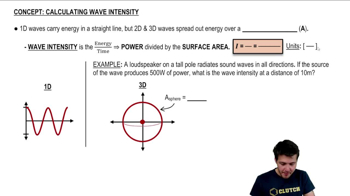
The intensity of light is defined as the power per unit area and is measured in watts per square meter (W/m²). In diffraction patterns, the intensity varies with position due to the interference of light waves. The intensity at the central maximum is typically the highest, and it decreases as one moves towards the minima, which are points of zero intensity.
Recommended video:
Guided course
02:32
Wave Intensity
Related Practice
Textbook Question

A single-slit diffraction pattern is formed by monochromatic electromagnetic radiation from a distant source passing through a slit 0.105 mm wide. At the point in the pattern 3.25° from the center of the central maximum, the total phase difference between wavelets from the top and bottom of the slit is 56.0 rad. What is the wavelength of the radiation?

1
views
Textbook Question

A series of parallel linear water wave fronts are traveling directly toward the shore at 15.0 cm/s on an otherwise placid lake. A long concrete barrier that runs parallel to the shore at a distance of 3.20 m away has a hole in it. You count the wave crests and observe that 75.0 of them pass by each minute, and you also observe that no waves reach the shore at ±61.3 cm from the point directly opposite the hole, but waves do reach the shore everywhere within this distance. At what other angles do you find no waves hitting the shore?

2
views
Textbook Question

A series of parallel linear water wave fronts are traveling directly toward the shore at 15.0 cm/s on an otherwise placid lake. A long concrete barrier that runs parallel to the shore at a distance of 3.20 m away has a hole in it. You count the wave crests and observe that 75.0 of them pass by each minute, and you also observe that no waves reach the shore at ±61.3 cm from the point directly opposite the hole, but waves do reach the shore everywhere within this distance. How wide is the hole in the barrier?

4
views
Textbook Question

Monochromatic light of wavelength 592 nm from a distant source passes through a slit that is 0.0290 mm wide. In the resulting diffraction pattern, the intensity at the center of the central maximum (θ = 0°) is 4.00x10⁻⁵ W/m2. What is the intensity at a point on the screen that corresponds to θ = 1.20°?

Textbook Question

Monochromatic light of wavelength 580 nm passes through a single slit and the diffraction pattern is observed on a screen. Both the source and screen are far enough from the slit for Fraunhofer diffraction to apply. (a) If the first diffraction minima are at ±90.0°, so the central maximum completely fills the screen, what is the width of the slit? (b) For the width of the slit as calculated in part (a), what is the ratio of the intensity at θ = 45.0° to the intensity at θ = 0?

2
views
Textbook Question

A slit 0.240 mm wide is illuminated by parallel light rays of wavelength 540 nm. The diffraction pattern is observed on a screen that is 3.00 m from the slit. The intensity at the center of the central maximum (θ = 0°) is 6.00 x 10⁻⁶ W/m2. What is the intensity at a point on the screen midway between the center of the central maximum and the first minimum?

1
views