
Textbook Question
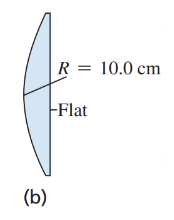
A lensmaker wants to make a magnifying glass from glass that has an index of refraction n = 1.55 and a focal length of 20.0 cm. If the two surfaces of the lens are to have equal radii, what should that radius be?
1
views
 Verified step by step guidance

 07:58
07:58
 03:46
03:46 05:38
05:38A lensmaker wants to make a magnifying glass from glass that has an index of refraction n = 1.55 and a focal length of 20.0 cm. If the two surfaces of the lens are to have equal radii, what should that radius be?
A 1.20 cm tall object is 50.0 cm to the left of a converging lens of focal length 40.0 cm. A second converging lens, this one having a focal length of 60.0 cm, is located 300.0 cm to the right of the first lens along the same optic axis. Find the location and height of the image (call it I1) formed by the lens with a focal length of 40.0 cm.
An object is 16.0 cm to the left of a lens. The lens forms an image 36.0 cm to the right of the lens. Draw a principal-ray diagram.
A converging lens with a focal length of 70.0 cm forms an image of a 3.20 cm tall real object that is to the left of the lens. The image is 4.50 cm tall and inverted. Where are the object and image located in relation to the lens? Is the image real or virtual?
An object is 16.0 cm to the left of a lens. The lens forms an image 36.0 cm to the right of the lens. If the object is 8.00 mm tall, how tall is the image? Is it erect or inverted?
A converging lens with a focal length of 9.00 cm forms an image of a 4.00 mm tall real object that is to the left of the lens. The image is 1.30 cm tall and erect. Where are the object and image located? Is the image real or virtual?