Ch 34: Geometric Optics
Young & Freedman Calc - University Physics 14th Edition
Young & Freedman Calc14th EditionUniversity PhysicsISBN: 9780321973610Not the one you use?Change textbook
Chapter 34, Problem 44a

BIO The Lens of the Eye. The crystalline lens of the human eye is a double-convex lens made of material having an index of refraction of 1.44 (although this varies). Its focal length in air is about 8.0 mm, which also varies. We shall assume that the radii of curvature of its two surfaces have the same magnitude. Find the radii of curvature of this lens.

Verified step by step guidance
1
Step 1: Recall the lens maker's formula, which relates the focal length \( f \), the index of refraction \( n \), and the radii of curvature \( R_1 \) and \( R_2 \) of a lens: \( \frac{1}{f} = (n - 1) \left( \frac{1}{R_1} - \frac{1}{R_2} \right) \).
Step 2: Since the problem states that the radii of curvature of the two surfaces have the same magnitude, we can set \( R_1 = R \) and \( R_2 = -R \) (the negative sign accounts for the opposite curvature direction). Substitute these into the lens maker's formula: \( \frac{1}{f} = (n - 1) \left( \frac{1}{R} - \frac{1}{-R} \right) \).
Step 3: Simplify the expression inside the parentheses: \( \frac{1}{R} - \frac{1}{-R} = \frac{1}{R} + \frac{1}{R} = \frac{2}{R} \). The formula now becomes \( \frac{1}{f} = (n - 1) \cdot \frac{2}{R} \).
Step 4: Rearrange the equation to solve for \( R \): \( R = 2(n - 1)f \).
Step 5: Substitute the given values: \( n = 1.44 \) and \( f = 8.0 \ \text{mm} \). Plug these into the equation to calculate \( R \): \( R = 2(1.44 - 1)(8.0) \). Perform the arithmetic to find the radius of curvature.

Verified video answer for a similar problem:

This video solution was recommended by our tutors as helpful for the problem above.
Video duration:
2m
Was this helpful?

Key Concepts

Here are the essential concepts you must grasp in order to answer the question correctly.

Lens Formula

The lens formula relates the focal length (f) of a lens to the object distance (u) and the image distance (v) through the equation 1/f = 1/v - 1/u. For a double-convex lens, the focal length is positive, indicating that it converges light. Understanding this formula is essential for calculating the radii of curvature based on the lens's focal length.
Recommended video:
05:38
Lens Maker Equation

Index of Refraction

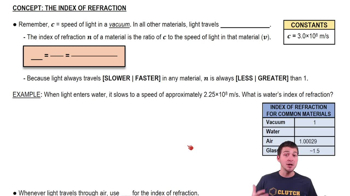
The index of refraction (n) is a dimensionless number that describes how light propagates through a medium. It is defined as the ratio of the speed of light in a vacuum to the speed of light in the medium. For the crystalline lens, with an index of refraction of 1.44, this property affects how light bends when entering and exiting the lens, influencing its focal length and curvature.
Recommended video:
Guided course
03:46
Index of Refraction

Radii of Curvature

The radii of curvature (R1 and R2) of a lens are the distances from the lens's surfaces to its center of curvature. For a double-convex lens, both surfaces have the same magnitude of curvature but opposite signs. These radii are crucial for applying the lens maker's equation, which relates the focal length of the lens to its radii of curvature and the index of refraction.
Recommended video:
Guided course
03:41
Speed of pulleys of different radii
Related Practice
Textbook Question

A camera lens has a focal length of 180.0 mm and an aperture diameter of 16.36 mm. What is the ƒ-number of the lens?

1
views
Textbook Question

Repeat Exercise 34.41 using the same lenses except for the following changes: The second lens is a diverging lens having a focal length of magnitude 60.0 cm.

3
views
Textbook Question

A 1.20 cm tall object is 50.0 cm to the left of a converging lens of focal length 40.0 cm. A second converging lens, this one having a focal length of 60.0 cm, is located 300.0 cm to the right of the first lens along the same optic axis. Find the location and height of the image (call it I1) formed by the lens with a focal length of 40.0 cm.

1
views
Textbook Question

An object is 16.0 cm to the left of a lens. The lens forms an image 36.0 cm to the right of the lens. Draw a principal-ray diagram.

2
views
Textbook Question

Zoom Lens. Consider the simple model of the zoom lens shown in Fig. 34.43a. The converging lens has focal length f1 = 12 cm, and the diverging lens has focal length f2 = -12 cm. The lenses are separated by 4 cm as shown in Fig. 34.43a. (a) For a distant object, where is the of the converging lens? (c) Where is the final image? Compare your answer to Fig. 34.43a.

1
views
Textbook Question

You wish to project the image of a slide on a screen 9.00 m from the lens of a slide projector. If the dimensions of the picture on a 35 mm color slide are 24 mm ✖ 36 mm, what is the minimum size of the projector screen required to accommodate the image?

1
views