Unpolarized light with intensity I0 is incident on two polarizing filters. The axis of the first filter makes an angle of 60.0° with the vertical, and the axis of the second filter is horizontal. What is the intensity of the light after it has passed through the second filter?
The indexes of refraction for violet light (λ = 400 nm) and red light (λ= 700 nm) in diamond are 2.46 and 2.41, respectively. A ray of light traveling through air strikes the diamond surface at an angle of 53.5° to the normal. Calculate the angular separation between these two colors of light in the refracted ray.
Verified step by step guidance
Verified video answer for a similar problem:
Key Concepts
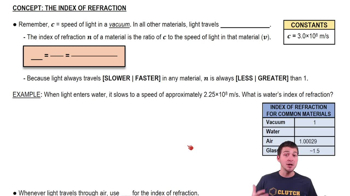
Index of Refraction
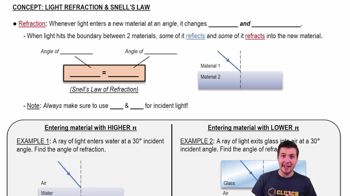
Snell's Law
Dispersion
A beam of light strikes a sheet of glass at an angle of 57.0° with the normal in air. You observe that red light makes an angle of 38.1° with the normal in the glass, while violet light makes a 36.7° angle. What are the speeds of red and violet light in the glass?
It is proposed to store 1.00 kWh = 3.60 × 10⁶ J of electrical energy in a uniform magnetic field with magnitude 0.600 T. If instead this amount of energy is to be stored in a volume (in vacuum) equivalent to a cube 40.0 cm on a side, what magnetic field is required?
Light enters a solid pipe made of plastic having an index of refraction of 1.60. The light travels parallel to the upper part of the pipe (Fig. E33.15). You want to cut the face AB so that all the light will reflect back into the pipe after it first strikes that face. If the pipe is immersed in water of refractive index 1.33, what is the largest that u can be?
The critical angle for total internal reflection at a liquid–air interface is 42.5°. If a ray of light traveling in the liquid has an angle of incidence at the interface of 35.0°, what angle does the refracted ray in the air make with the normal?
At the very end of Wagner's series of operas Ring of the Nibelung, Brünnhilde takes the golden ring from the finger of the dead Siegfried and throws it into the Rhine, where it sinks to the bottom of the river. Assuming that the ring is small enough compared to the depth of the river to be treated as a point and that the Rhine is 10.0 m deep where the ring goes in, what is the area of the largest circle at the surface of the water over which light from the ring could escape from the water?
