
Ch 30: Inductance
Young & Freedman Calc - University Physics 14th Edition
Young & Freedman Calc14th EditionUniversity PhysicsISBN: 9780321973610Not the one you use?Change textbook
Chapter 30, Problem 15b

Inductance of a Solenoid. A metallic laboratory spring is typically 5.00 cm long and 0.150 cm in diameter and has 50 coils. If you connect such a spring in an electric circuit, how much self-inductance must you include for it if you model it as an ideal solenoid?

Verified step by step guidance
1
Understand the formula for the inductance of a solenoid: \( L = \frac{\mu_0 N^2 A}{l} \), where \( L \) is the inductance, \( \mu_0 \) is the permeability of free space, \( N \) is the number of turns, \( A \) is the cross-sectional area, and \( l \) is the length of the solenoid.
Calculate the cross-sectional area \( A \) of the solenoid using the formula for the area of a circle: \( A = \pi r^2 \). The radius \( r \) is half of the diameter, so \( r = \frac{0.150 \text{ cm}}{2} \). Convert the radius to meters before calculating the area.
Convert the length of the solenoid from centimeters to meters. The length \( l \) is given as 5.00 cm, which is equivalent to 0.050 meters.
Substitute the values into the inductance formula. Use \( \mu_0 = 4\pi \times 10^{-7} \text{ T m/A} \) for the permeability of free space, \( N = 50 \) for the number of coils, and the calculated values for \( A \) and \( l \).
Simplify the expression to find the self-inductance \( L \) of the solenoid. Ensure all units are consistent, and perform the necessary arithmetic operations to complete the calculation.

Verified video answer for a similar problem:

This video solution was recommended by our tutors as helpful for the problem above.
Video duration:
1m
Was this helpful?

Key Concepts

Here are the essential concepts you must grasp in order to answer the question correctly.

Inductance

Inductance is a property of an electrical conductor that quantifies its ability to induce an electromotive force (EMF) when the current flowing through it changes. It is measured in henries (H) and is crucial for understanding how solenoids and other inductive components behave in circuits, affecting energy storage and transfer.
Recommended video:
Guided course
12:59
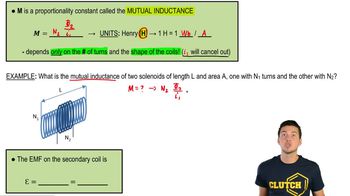
Mutual Induction

Solenoid

A solenoid is a coil of wire designed to create a magnetic field when an electric current passes through it. The inductance of a solenoid depends on its physical characteristics, such as the number of turns, length, and cross-sectional area, as well as the permeability of the core material. Solenoids are used in various applications, including electromagnets and inductors.
Recommended video:
Guided course
11:47
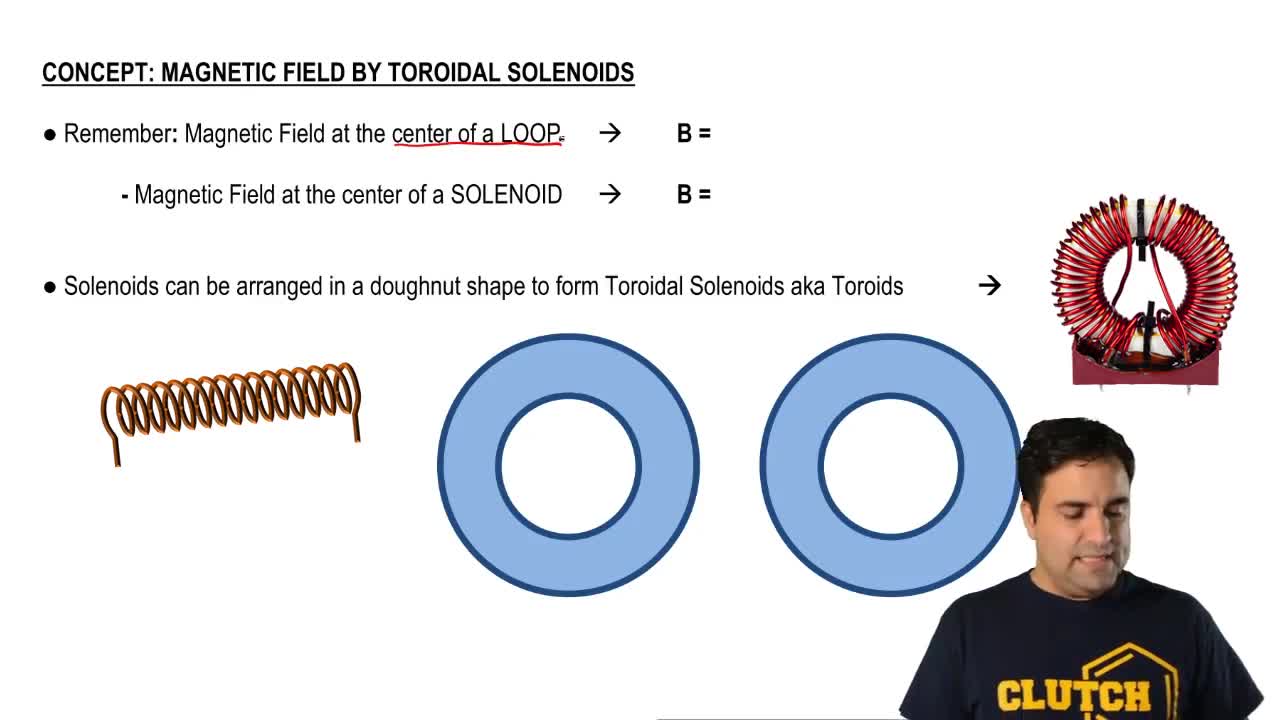
Toroidal Solenoids aka Toroids

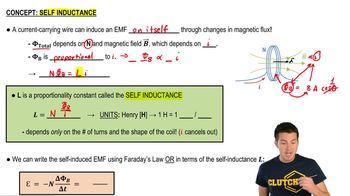
Self-Inductance Formula for Solenoids

The self-inductance of a solenoid can be calculated using the formula L = (μ₀ * N² * A) / l, where L is the inductance, μ₀ is the permeability of free space, N is the number of turns, A is the cross-sectional area, and l is the length of the solenoid. This formula helps determine how the solenoid will behave in an electrical circuit, particularly in terms of energy storage and magnetic field generation.
Recommended video:
Guided course
07:58
Self Inductance