
Ch 29: Electromagnetic Induction
Young & Freedman Calc - University Physics 14th Edition
Young & Freedman Calc14th EditionUniversity PhysicsISBN: 9780321973610Not the one you use?Change textbook
Chapter 29, Problem 13

The armature of a small generator consists of a flat, square coil with 120 turns and sides with a length of 1.60 cm. The coil rotates in a magnetic field of 0.0750 T. What is the angular speed of the coil if the maximum emf produced is 24.0 mV?

Verified step by step guidance
1
First, understand that the maximum electromotive force (emf) produced by a rotating coil in a magnetic field is given by the formula: E=NBAω, where E is the maximum emf, N is the number of turns, B is the magnetic field strength, A is the area of the coil, and ω is the angular speed.
Calculate the area of the coil. Since the coil is square with sides of length 1.60 cm, convert this length to meters (0.0160 m) and use the formula for the area of a square: A=s2, where s is the side length.
Substitute the known values into the emf formula: 24.0×10-3=120×0.0750×A×ω. Solve for ω.
Rearrange the formula to solve for angular speed: ω=ENBA. Substitute the values for E, N, B, and A into this equation.
Perform the calculation to find the angular speed ω. Ensure all units are consistent, particularly converting cm to m for the area calculation.

Verified video answer for a similar problem:

This video solution was recommended by our tutors as helpful for the problem above.
Video duration:
3m
Was this helpful?

Key Concepts

Here are the essential concepts you must grasp in order to answer the question correctly.

Electromagnetic Induction

Electromagnetic induction is the process by which a changing magnetic field within a coil induces an electromotive force (emf). According to Faraday's Law, the induced emf is proportional to the rate of change of the magnetic flux through the coil. This principle is fundamental in understanding how generators convert mechanical energy into electrical energy.
Recommended video:
Guided course
05:42
Introduction to Induction

Magnetic Flux

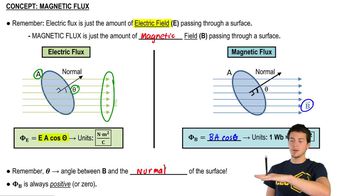
Magnetic flux refers to the quantity of magnetic field passing through a given area, such as a coil. It is calculated as the product of the magnetic field strength, the area of the coil, and the cosine of the angle between the field and the normal to the coil's surface. Understanding magnetic flux is crucial for determining how the rotation of the coil affects the induced emf.
Recommended video:
Guided course
04:52
Magnetic Flux

Angular Speed

Angular speed is the rate at which an object rotates or revolves around an axis, measured in radians per second. In the context of a generator, the angular speed of the coil affects the rate of change of magnetic flux, thereby influencing the maximum emf produced. Calculating angular speed involves understanding the relationship between rotational motion and electromagnetic induction.
Recommended video:
Guided course
07:59
Speed Distribution & Special Speeds of Ideal Gases
Related Practice
Textbook Question

Shrinking Loop. A circular loop of flexible iron wire has an initial circumference of 165.0 cm, but its circumference is decreasing at a constant rate of 12.0 cm/s due to a tangential pull on the wire. The loop is in a constant, uniform magnetic field oriented perpendicular to the plane of the loop and with magnitude 0.500 T. Find the emf induced in the loop at the instant when 9.0 s have passed.

2
views
Textbook Question

Shrinking Loop. A circular loop of flexible iron wire has an initial circumference of 165.0 cm, but its circumference is decreasing at a constant rate of 12.0 cm/s due to a tangential pull on the wire. The loop is in a constant, uniform magnetic field oriented perpendicular to the plane of the loop and with magnitude 0.500 T. Find the direction of the induced current in the loop as viewed looking along the direction of the magnetic field.

2
views
Textbook Question

A flat, rectangular coil of dimensions l and w is pulled with uniform speed v through a uniform magnetic field B with the plane of its area perpendicular to the field (Fig. E29.14). (a) Find the emf induced in this coil. (b) If the speed and magnetic field are both tripled, what is the induced emf?

Textbook Question

A circular loop of wire is in a region of spatially uniform magnetic field, as shown in Fig. E29.15. The magnetic field is directed into the plane of the figure. Determine the direction (clockwise or counterclockwise) of the induced current in the loop when (a) B is increasing; (b) B is decreasing; (c) B is constant with value B0. Explain your reasoning.

1
views
Textbook Question

A closely wound rectangular coil of 80 turns has dimen-sions of 25.0 cm by 40.0 cm. The plane of the coil is rotated from a position where it makes an angle of 37.0° with a magnetic field of 1.70 T to a position perpendicular to the field. The rotation takes 0.0600 s. What is the average emf induced in the coil?

Textbook Question

The current in Fig. E29.18E29.18 obeys the equation I(t)=I0ebtI(t)=I_0e^{-bt}, where b>0b > 0. Find the direction (clockwise or counterclockwise) of the current induced in the round coil for t>0t > 0.

1
views