
Ch 29: Electromagnetic Induction
Young & Freedman Calc - University Physics 14th Edition
Young & Freedman Calc14th EditionUniversity PhysicsISBN: 9780321973610Not the one you use?Change textbook
Chapter 29, Problem 2a

In a physics laboratory experiment, a coil with 200 turns enclosing an area of 12 cm2 is rotated in 0.040 s from a position where its plane is perpendicular to the earth's magnetic field to a position where its plane is parallel to the field. The earth's magnetic field at the lab location is 6.0 × 10⁻⁵ T. What is the total magnetic flux through the coil before it is rotated? After it is rotated?

Verified step by step guidance
1
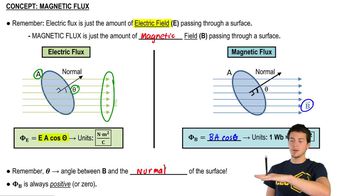
First, understand the concept of magnetic flux. Magnetic flux (Φ) through a surface is given by the formula Φ = B * A * cos(θ), where B is the magnetic field, A is the area, and θ is the angle between the magnetic field and the normal to the surface.
Calculate the initial magnetic flux when the coil's plane is perpendicular to the magnetic field. In this position, θ = 0 degrees, so cos(θ) = 1. Use the formula Φ_initial = B * A * cos(0) = B * A.
Substitute the given values into the formula for initial flux: B = 6.0 * 10^-5 T and A = 12 cm^2 (convert this to m^2 by dividing by 10,000). Calculate Φ_initial = (6.0 * 10^-5 T) * (12 * 10^-4 m^2).
Next, calculate the magnetic flux after the coil is rotated to a position where its plane is parallel to the magnetic field. In this position, θ = 90 degrees, so cos(θ) = 0. Use the formula Φ_final = B * A * cos(90) = 0.
Conclude that the total magnetic flux through the coil after it is rotated is zero, as the plane of the coil is parallel to the magnetic field, resulting in no flux passing through the coil.

Verified video answer for a similar problem:

This video solution was recommended by our tutors as helpful for the problem above.
Video duration:
4m
Was this helpful?

Key Concepts

Here are the essential concepts you must grasp in order to answer the question correctly.

Magnetic Flux

Magnetic flux quantifies the amount of magnetic field passing through a given area. It is calculated as the product of the magnetic field strength, the area it penetrates, and the cosine of the angle between the field and the normal to the surface. In this scenario, the flux changes as the coil rotates, affecting the angle between the field and the coil's plane.
Recommended video:
Guided course
04:52
Magnetic Flux

Faraday's Law of Electromagnetic Induction

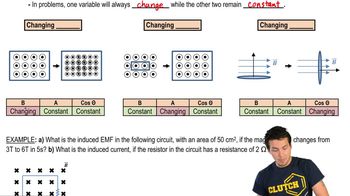
Faraday's Law states that a change in magnetic flux through a coil induces an electromotive force (EMF) in the coil. This principle is crucial for understanding how rotating the coil affects the magnetic flux and potentially induces a current. The law is expressed as EMF = -dΦ/dt, where Φ is the magnetic flux.
Recommended video:
Guided course
09:26
Faraday's Law

Orientation of Coil Relative to Magnetic Field

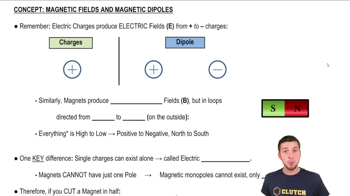
The orientation of the coil relative to the magnetic field determines the angle used in calculating magnetic flux. Initially, when the coil's plane is perpendicular to the field, the angle is 0 degrees, maximizing flux. When parallel, the angle is 90 degrees, minimizing flux. Understanding this orientation change is key to solving the problem.
Recommended video:
Guided course
05:30
Magnetic Fields and Magnetic Dipoles
Related Practice
Textbook Question

A single loop of wire with an area of 0.0900 m2 is in a uniform magnetic field that has an initial value of 3.80 T, is perpendicular to the plane of the loop, and is decreasing at a constant rate of 0.190 T/s. What emf is induced in this loop?

Textbook Question

Shrinking Loop. A circular loop of flexible iron wire has an initial circumference of 165.0 cm, but its circumference is decreasing at a constant rate of 12.0 cm/s due to a tangential pull on the wire. The loop is in a constant, uniform magnetic field oriented perpendicular to the plane of the loop and with magnitude 0.500 T. Find the emf induced in the loop at the instant when 9.0 s have passed.

2
views
Textbook Question

Shrinking Loop. A circular loop of flexible iron wire has an initial circumference of 165.0 cm, but its circumference is decreasing at a constant rate of 12.0 cm/s due to a tangential pull on the wire. The loop is in a constant, uniform magnetic field oriented perpendicular to the plane of the loop and with magnitude 0.500 T. Find the direction of the induced current in the loop as viewed looking along the direction of the magnetic field.

2
views
Textbook Question

In a physics laboratory experiment, a coil with 200 turns enclosing an area of 12 cm2 is rotated in 0.040 s from a position where its plane is perpendicular to the earth's magnetic field to a position where its plane is parallel to the field. The earth's magnetic field at the lab location is 6.0 × 10⁻⁵ T. What is the average emf induced in the coil?

Textbook Question

A single loop of wire with an area of 0.0900 m2 is in a uniform magnetic field that has an initial value of 3.80 T, is perpendicular to the plane of the loop, and is decreasing at a constant rate of 0.190 T/s. If the loop has a resistance of 0.600 Ω, find the current induced in the loop.

1
views