Ch 29: Electromagnetic Induction
Young & Freedman Calc - University Physics 14th Edition
Young & Freedman Calc14th EditionUniversity PhysicsISBN: 9780321973610Not the one you use?Change textbook
Chapter 29, Problem 36a

A metal ring 4.50 cm in diameter is placed between the north and south poles of large magnets with the plane of its area perpendicular to the magnetic field. These magnets produce an initial uniform field of 1.12 T between them but are gradually pulled apart, causing this field to remain uniform but decrease steadily at 0.250 T/s. What is the magnitude of the electric field induced in the ring?

Verified step by step guidance
1
First, understand that the problem involves electromagnetic induction, specifically Faraday's law of induction, which states that a changing magnetic field within a closed loop induces an electromotive force (EMF) in the loop.
Calculate the area of the metal ring. The diameter is given as 4.50 cm, so the radius is half of that. Convert the radius to meters and use the formula for the area of a circle: \( A = \pi r^2 \).
Determine the rate of change of the magnetic flux through the ring. The magnetic flux \( \Phi \) is given by \( \Phi = B \times A \), where \( B \) is the magnetic field and \( A \) is the area. Since the magnetic field is changing at a rate of 0.250 T/s, the rate of change of flux is \( \frac{d\Phi}{dt} = A \times \frac{dB}{dt} \).
Apply Faraday's law of induction, which states that the induced EMF (\( \mathcal{E} \)) is equal to the negative rate of change of magnetic flux: \( \mathcal{E} = -\frac{d\Phi}{dt} \). Substitute the expression for \( \frac{d\Phi}{dt} \) from the previous step.
Finally, relate the induced EMF to the induced electric field \( E \) around the ring. Since the EMF is the work done per unit charge around the loop, and the loop is circular, \( \mathcal{E} = E \times 2\pi r \). Solve for \( E \) using the expression for \( \mathcal{E} \) obtained from Faraday's law.

Verified video answer for a similar problem:

This video solution was recommended by our tutors as helpful for the problem above.
Video duration:
5m
Was this helpful?

Key Concepts

Here are the essential concepts you must grasp in order to answer the question correctly.

Faraday's Law of Electromagnetic Induction

Faraday's Law states that a change in magnetic flux through a circuit induces an electromotive force (EMF) in the circuit. The induced EMF is equal to the negative rate of change of magnetic flux. In this scenario, the changing magnetic field through the metal ring induces an electric field, which can be calculated using this principle.
Recommended video:
Guided course
09:26
Faraday's Law

Magnetic Flux

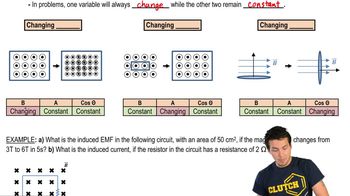
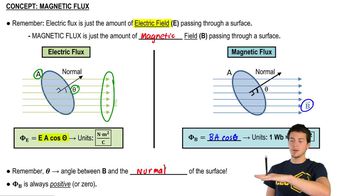
Magnetic flux refers to the total magnetic field passing through a given area. It is calculated as the product of the magnetic field strength, the area it penetrates, and the cosine of the angle between the field and the normal to the surface. In this problem, the magnetic flux changes as the magnetic field strength decreases, leading to an induced electric field.
Recommended video:
Guided course
04:52
Magnetic Flux

Induced Electric Field

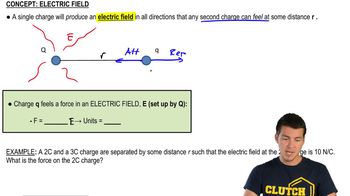
An induced electric field arises in a region where the magnetic field changes over time. According to Faraday's Law, this field is related to the rate of change of magnetic flux. The magnitude of the induced electric field in the ring can be determined by considering the rate at which the magnetic field decreases and the geometry of the ring.
Recommended video:
Guided course
03:16
Intro to Electric Fields
Related Practice
Textbook Question

The magnetic field within a long, straight solenoid with a circular cross section and radius R is increasing at a rate of dB/dt. What is the magnitude of the induced emf if the radius in part (d) is 2R?

1
views
Textbook Question

A circular loop of wire with radius r = 0.0480 m and resistance R = 0.160 Ω is in a region of spatially uniform magnetic field, as shown in Fig. E29.22. The magnetic field is directed out of the plane of the figure. The magnetic field has an initial value of 8.00 T and is decreasing at a rate of dB/dt = -0.680 T/s. Is the induced current in the loop clockwise or counterclockwise?

1
views
Textbook Question

The magnetic field within a long, straight solenoid with a circular cross section and radius R is increasing at a rate of dB/dt. What is the magnitude of the induced emf in a circular turn of radius R/2 that has its center on the solenoid axis?

1
views
Textbook Question

A long, thin solenoid has 900 turns per meter and radius 2.50 cm. The current in the solenoid is increasing at a uniform rate of 36.0 A/s. What is the magnitude of the induced electric field at a point near the center of the solenoid and (a) 0.500 cm from the axis of the solenoid; (b) 1.00 cm from the axis of the solenoid?

1
views
Textbook Question

A cardboard tube is wrapped with two windings of insulated wire wound in opposite directions, as shown in Fig. E29.20. Terminals a and b of winding A may be connected to a battery through a reversing switch. State whether the induced current in the resistor R is from left to right or from right to left in the following circumstances: (a) the current in winding Ais from a to b and is increasing; (b) the current in winding A is from b to a and is decreasing; (c) the current in winding A is from b to a and is increasing.

1
views
Textbook Question

The conducting rod ab shown in Fig. E29.29 makes contact with metal rails ca and db. The apparatus is in a uniform magnetic field of 0.800 T, perpendicular to the plane of the figure. In what direction does the current flow in the rod?