
Ch 31: Alternating Current
Young & Freedman Calc - University Physics 14th Edition
Young & Freedman Calc14th EditionUniversity PhysicsISBN: 9780321973610Not the one you use?Change textbook
Chapter 31, Problem 23a

An L-R-C series circuit with L = 0.120 H, R = 240 Ω, and C = 7.30 μF carries an rms current of 0.450 A with a frequency of 400 Hz. What are the phase angle and power factor for this circuit?

Verified step by step guidance
1
First, calculate the inductive reactance (X_L) using the formula: XL=ωL, where ω is the angular frequency given by ω=2πf. Substitute the values for L and f to find X_L.
Next, calculate the capacitive reactance (X_C) using the formula: XC=1ωC. Substitute the values for C and f to find X_C.
Determine the impedance (Z) of the circuit using the formula: Z=R2+(XL-XC)2. Substitute the values for R, X_L, and X_C to find Z.
Calculate the phase angle (φ) using the formula: φ=tan-1(XL-XCR). Substitute the values for X_L, X_C, and R to find φ.
Finally, determine the power factor (pf) using the formula: pf=cos(φ). Use the phase angle calculated in the previous step to find the power factor.

Verified video answer for a similar problem:

This video solution was recommended by our tutors as helpful for the problem above.
Video duration:
5m
Was this helpful?

Key Concepts

Here are the essential concepts you must grasp in order to answer the question correctly.

Impedance in L-R-C Circuits

Impedance in an L-R-C circuit is the total opposition to the flow of alternating current, combining resistance (R), inductive reactance (X_L), and capacitive reactance (X_C). It is calculated using Z = √(R² + (X_L - X_C)²), where X_L = 2πfL and X_C = 1/(2πfC). Understanding impedance is crucial for determining the phase angle and power factor.
Recommended video:
Guided course
08:40
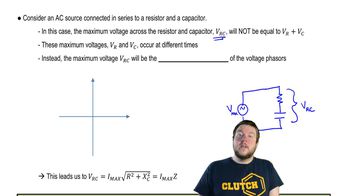
Impedance in AC Circuits

Phase Angle

The phase angle in an L-R-C circuit indicates the phase difference between the voltage across the circuit and the current through it. It is determined by the arctangent of the reactance difference over resistance: φ = arctan((X_L - X_C)/R). A positive phase angle suggests the circuit is inductive, while a negative angle indicates it is capacitive.
Recommended video:
Guided course
08:59
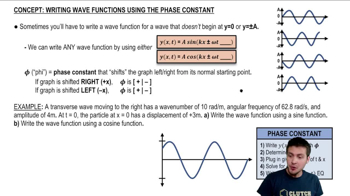
Phase Constant of a Wave Function

Power Factor

The power factor in an L-R-C circuit is the cosine of the phase angle, representing the ratio of real power used in the circuit to the apparent power. It is calculated as cos(φ), where φ is the phase angle. A power factor close to 1 indicates efficient power usage, while a lower value suggests more reactive power is present.
Recommended video:
Related Practice
Textbook Question

In an L-R-C series circuit, the components have the following values: L = 20.0 mH, C = 140 nF, and R = 350 Ω.The generator has an rms voltage of 120 V and a frequency of 1.25 kHz. Determine (a) the power supplied by the generator and (b) the power dissipated in the resistor.

1
views
Textbook Question

Off to Europe! You plan to take your hair dryer to Europe, where the electrical outlets put out 240 V instead of the 120 V seen in the United States. The dryer puts out 1600 W at 120 V. What could you do to operate your dryer via the 240 V line in Europe?

2
views
Textbook Question

A series ac circuit contains a 250-Ω resistor, a 15-mH inductor, a 3.5-μF capacitor, and an ac power source of voltage amplitude 45 V operating at an angular frequency of 360 rad/s.What is the power factor of this circuit?

2
views
Textbook Question

An L-R-C series circuit is connected to a 120-Hz ac source that has Vrms = 80.0 V. The circuit has a resistance of 75.0 Ω and an impedance at this frequency of 105 Ω. What average power is delivered to the circuit by the source?

2
views
Textbook Question

A resistor with R = 300 Ω and an inductor are connected in series across an ac source that has voltage amplitude 500 V. The rate at which electrical energy is dissipated in the resistor is 286 W. What is (a) the impedance Z of the circuit; (b) the amplitude of the voltage across the inductor; (c) the power factor?

2
views
Textbook Question

The power of a certain CD player operating at 120 V rms is 20.0 W. Assuming that the CD player behaves like a pure resistor, find the maximum instantaneous power.

1
views