

A solid conductor with radius a is supported by insulating disks on the axis of a conducting tube with inner radius b and outer radius c (Fig. E28.43). The central conductor and tube carry equal currents I in opposite directions. The currents are distributed uniformly over the cross sections of each conductor. Derive an expression for the magnitude of the magnetic field at points outside the tube (r > c).
Ch 28: Sources of Magnetic Field
Young & Freedman Calc14th EditionUniversity PhysicsISBN: 9780321973610Not the one you use?Change textbook
Chapter 28, Problem 47b
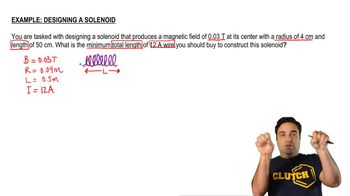
A solenoid is designed to produce a magnetic field of 0.0270 T at its center. It has radius 1.40 cm and length 40.0 cm, and the wire can carry a maximum current of 12.0 A. What total length of wire is required?
Verified step by step guidance1
First, understand that the magnetic field inside a solenoid is given by the formula: , where is the magnetic field, is the permeability of free space, is the number of turns per unit length, and is the current.
Rearrange the formula to solve for : . Substitute the given values: T, A, and T·m/A.
Calculate the number of turns per unit length using the rearranged formula.
Once is found, calculate the total number of turns by multiplying by the length of the solenoid: m.
Finally, calculate the total length of wire required by multiplying the number of turns by the circumference of the solenoid: m.

Verified video answer for a similar problem:
This video solution was recommended by our tutors as helpful for the problem above.
Video duration:
5mWas this helpful?
Key Concepts
Here are the essential concepts you must grasp in order to answer the question correctly.
Magnetic Field of a Solenoid
The magnetic field inside a solenoid is uniform and parallel to its axis, given by B = μ₀nI, where B is the magnetic field, μ₀ is the permeability of free space, n is the number of turns per unit length, and I is the current. Understanding this formula is crucial for calculating the required parameters of the solenoid.
Recommended video:
Guided course
Magnetic Field Produced by Loops and Solenoids
Number of Turns in a Solenoid
The number of turns per unit length, n, is a key factor in determining the magnetic field strength of a solenoid. It is calculated as n = N/L, where N is the total number of turns and L is the length of the solenoid. This concept helps in understanding how the solenoid's design affects its magnetic properties.
Recommended video:
Guided course
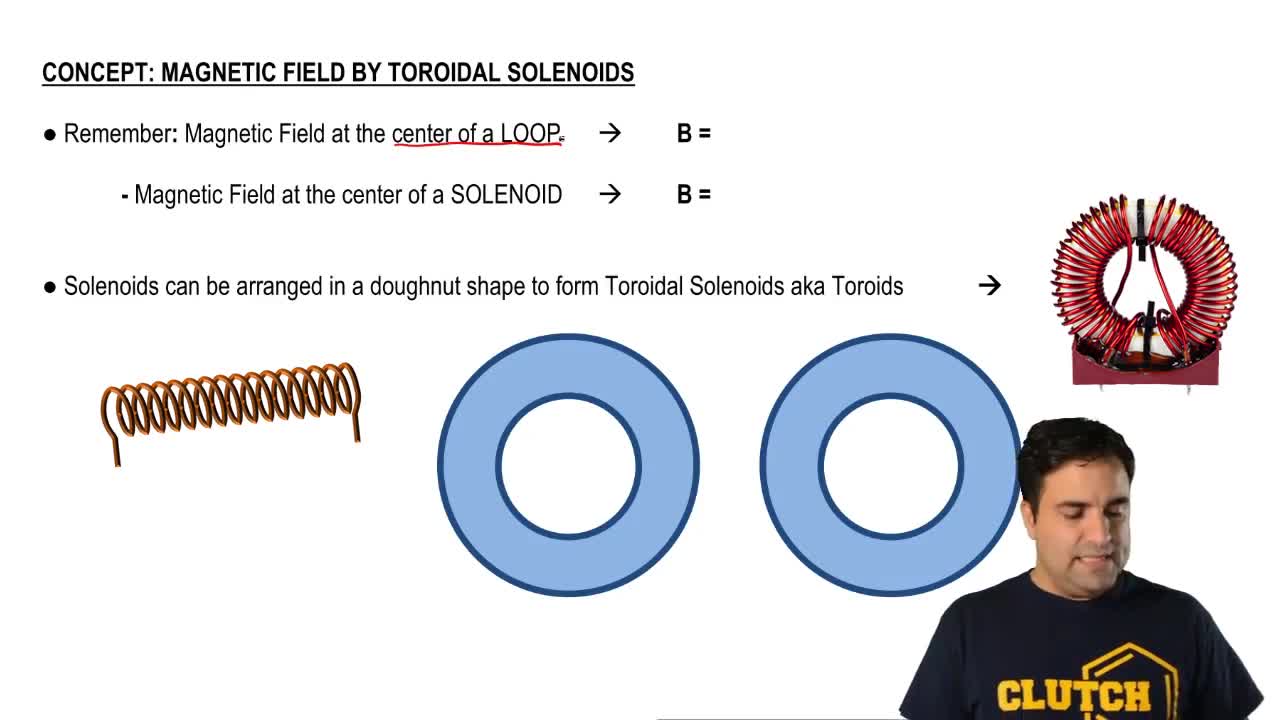
Toroidal Solenoids aka Toroids
Length of Wire in a Solenoid
The total length of wire required for a solenoid is determined by the number of turns and the circumference of the solenoid. It is calculated using the formula: total wire length = N × 2πr, where N is the number of turns and r is the radius of the solenoid. This concept is essential for solving the problem of wire length needed to achieve the desired magnetic field.
Recommended video:
Guided course
Designing a Solenoid (Total Length of Wire)
Related Practice
Textbook Question
1
views
Textbook Question
A solenoid is designed to produce a magnetic field of 0.0270 T at its center. It has radius 1.40 cm and length 40.0 cm, and the wire can carry a maximum current of 12.0 A. What minimum number of turns per unit length must the solenoid have?
14
views
Textbook Question
A 15.0 cm long solenoid with radius 0.750 cm is closely wound with 600 turns of wire. The current in the windings is 8.00 A. Compute the magnetic field at a point near the center of the solenoid.
1
views
