Ch 27: Magnetic Field and Magnetic Forces
Young & Freedman Calc - University Physics 14th Edition
Young & Freedman Calc14th EditionUniversity PhysicsISBN: 9780321973610Not the one you use?Change textbook
Chapter 27, Problem 5

An electron experiences a magnetic force of magnitude 4.60 x10⁻¹⁵ N when moving at an angle of 60.0° with respect to a magnetic field of magnitude 3.50 x 10⁻³ T. Find the speed of the electron.

Verified step by step guidance
1
Identify the formula for the magnetic force on a moving charge: \( F = qvB \sin(\theta) \), where \( F \) is the magnetic force, \( q \) is the charge of the electron, \( v \) is the speed of the electron, \( B \) is the magnetic field strength, and \( \theta \) is the angle between the velocity and the magnetic field.
Rearrange the formula to solve for the speed \( v \): \( v = \frac{F}{qB \sin(\theta)} \).
Substitute the known values into the equation: \( F = 4.60 \times 10^{-15} \) N, \( q = 1.60 \times 10^{-19} \) C (the charge of an electron), \( B = 3.50 \times 10^{-3} \) T, and \( \theta = 60.0^\circ \).
Calculate \( \sin(60.0^\circ) \), which is a trigonometric function value that can be found using a calculator or trigonometric table.
Substitute all the values into the rearranged formula to find \( v \): \( v = \frac{4.60 \times 10^{-15}}{1.60 \times 10^{-19} \times 3.50 \times 10^{-3} \times \sin(60.0^\circ)} \).

Verified video answer for a similar problem:

This video solution was recommended by our tutors as helpful for the problem above.
Video duration:
3m
Was this helpful?

Key Concepts

Here are the essential concepts you must grasp in order to answer the question correctly.

Magnetic Force on a Moving Charge

The magnetic force on a moving charge is given by the equation F = qvBsin(θ), where F is the force, q is the charge, v is the velocity of the charge, B is the magnetic field strength, and θ is the angle between the velocity and the magnetic field. This equation is crucial for determining the speed of the electron in the given problem.
Recommended video:
Guided course
09:08
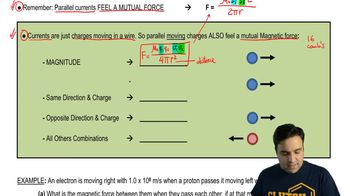
Magnetic Force Between Two Moving Charges

Trigonometric Functions

Trigonometric functions, such as sine, are used to resolve components of vectors in physics. In this context, sin(θ) is used to calculate the component of the velocity that is perpendicular to the magnetic field, which is necessary for determining the magnetic force experienced by the electron.
Recommended video:
Guided course
08:30
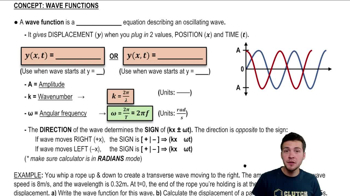
Intro to Wave Functions

Electron Charge

The charge of an electron is a fundamental constant, approximately -1.60x10^-19 C. Knowing this value is essential for calculating the speed of the electron, as it is a key variable in the equation for magnetic force. The negative sign indicates the electron's negative charge, but the magnitude is used in calculations involving force.
Recommended video:
Guided course
04:32
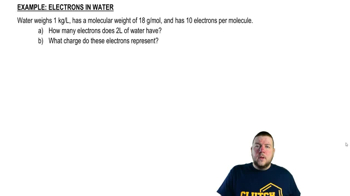
Electrons In Water (Using Density)