
Ch 22: Gauss' Law
Young & Freedman Calc - University Physics 14th Edition
Young & Freedman Calc14th EditionUniversity PhysicsISBN: 9780321973610Not the one you use?Change textbook
Chapter 22, Problem 19c

A hollow, conducting sphere with an outer radius of 0.2500.250 m and an inner radius of 0.2000.200 m has a uniform surface charge density of +6.37×10⁶+6.37\(\times\)10^{-6} C/m2. A charge of 0.500−0.500 μ\(\mu\)C is now introduced at the center of the cavity inside the sphere. What is the electric flux through a spherical surface just inside the inner surface of the sphere?

Verified step by step guidance
1
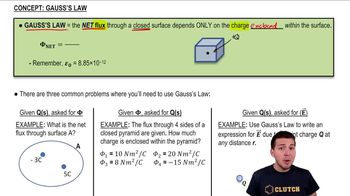
First, understand that the electric flux through a closed surface is given by Gauss's Law, which states that the electric flux Φ through a closed surface is equal to the charge enclosed Q divided by the permittivity of free space ε₀: Φ = Q/ε₀.
Identify the charge enclosed by the spherical surface just inside the inner surface of the sphere. Since the charge of -0.500 μC is introduced at the center of the cavity, this is the charge enclosed by the surface.
Convert the charge from microcoulombs to coulombs for calculation purposes. Recall that 1 μC = 1×10⁻⁶ C, so -0.500 μC = -0.500×10⁻⁶ C.
Use Gauss's Law to calculate the electric flux. Substitute the charge enclosed (-0.500×10⁻⁶ C) into the formula Φ = Q/ε₀, where ε₀ is the permittivity of free space, approximately 8.85×10⁻¹² C²/(N·m²).
Perform the division to find the electric flux Φ through the spherical surface just inside the inner surface of the sphere. Remember, the direction of the electric field lines will be inward due to the negative charge.

Verified video answer for a similar problem:

This video solution was recommended by our tutors as helpful for the problem above.
Video duration:
2m
Was this helpful?

Key Concepts

Here are the essential concepts you must grasp in order to answer the question correctly.

Gauss's Law

Gauss's Law relates the electric flux through a closed surface to the charge enclosed by that surface. It states that the total electric flux is equal to the enclosed charge divided by the permittivity of free space. This principle is crucial for calculating the electric flux through surfaces surrounding charged objects, such as the spherical surface inside the conducting sphere.
Recommended video:

Electric Flux

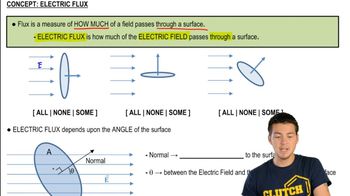
Electric flux is a measure of the electric field passing through a given surface. It is calculated as the product of the electric field and the area through which the field lines pass, considering the angle between the field lines and the surface normal. Understanding electric flux is essential for determining how electric fields interact with surfaces, especially in the context of Gauss's Law.
Recommended video:
Guided course
05:43
Electric Flux

Conductors and Charge Distribution

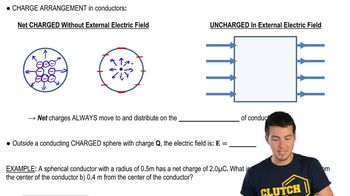
Conductors allow charges to move freely, resulting in charge distribution on their surfaces. In electrostatic equilibrium, the electric field inside a conductor is zero, and any excess charge resides on the surface. This concept is important for understanding how the introduced charge affects the electric field and flux within the hollow sphere, as charges will redistribute to maintain equilibrium.
Recommended video:
Guided course
07:43
Electric Fields in Conductors
Related Practice
Textbook Question

Charge qq is distributed uniformly throughout the volume of an insulating sphere of radius R=4.00R = 4.00 cm. At a distance of r=8.00r = 8.00 cm from the center of the sphere, the electric field due to the charge distribution has magnitude E=940E = 940 N/C. What is the volume charge density for the sphere?

Textbook Question

A conductor with an inner cavity, like that shown in Fig. 22.2322.23c, carries a total charge of +5.00+5.00 nC. The charge within the cavity, insulated from the conductor, is 6.00−6.00 nC. How much charge is on (a) the inner surface of the conductor and (b) the outer surface of the conductor?

Textbook Question

A hollow, conducting sphere with an outer radius of 0.2500.250 m and an inner radius of 0.2000.200 m has a uniform surface charge density of +6.37×10⁶+6.37\(\times\)10^{-6} C/m2. A charge of 0.500−0.500 μ\(\mu\)C is now introduced at the center of the cavity inside the sphere. What is the new charge density on the outside of the sphere?

Textbook Question

Charge qq is distributed uniformly throughout the volume of an insulating sphere of radius R=4.00R = 4.00 cm. At a distance of r=8.00r = 8.00 cm from the center of the sphere, the electric field due to the charge distribution has magnitude E=940E = 940 N/C. What is the electric field at a distance of 2.002.00 cm from the sphere's center?

Textbook Question

A very long uniform line of charge has charge per unit length 4.804.80 μ\(\mu\)C/m and lies along the xx-axis. A second long uniform line of charge has charge per unit length 2.40-2.40 μ\(\mu\)C/m and is parallel to the xx-axis at y=0.400y = 0.400 m. What is the net electric field (magnitude and direction) at the following points on the yy-axis: (a) y=0.200y = 0.200 m and (b) y=0.600 y = 0.600 m?

1
views
Textbook Question

A hollow, conducting sphere with an outer radius of 0.2500.250 m and an inner radius of 0.2000.200 m has a uniform surface charge density of +6.37×10⁶+6.37\(\times\)10^{-6} C/m2. A charge of 0.500−0.500 μ\(\mu\)C is now introduced at the center of the cavity inside the sphere. Calculate the strength of the electric field just outside the sphere?