
Ch 21: Electric Charge and Electric Field
Young & Freedman Calc - University Physics 14th Edition
Young & Freedman Calc14th EditionUniversity PhysicsISBN: 9780321973610Not the one you use?Change textbook
Chapter 21, Problem 37b

Two positive point charges qq are placed on the xx-axis, one at x=ax = a and one at x=ax = -a. Derive an expression for the electric field at points on the xx-axis. Use your result to graph the xx-component of the electric field as a function of xx, for values of xx between 4a-4a and +4a+4a.

Verified step by step guidance
1
Start by considering the electric field due to a single point charge. The electric field \( E \) due to a point charge \( q \) at a distance \( r \) is given by \( E = \frac{kq}{r^2} \), where \( k \) is Coulomb's constant.
For the charge at \( x = a \), the distance to a point \( x \) on the x-axis is \( |x - a| \). The electric field due to this charge at point \( x \) is \( E_1 = \frac{kq}{(x - a)^2} \). The direction of this field is along the x-axis, pointing away from the charge if \( x > a \) and towards the charge if \( x < a \).
Similarly, for the charge at \( x = -a \), the distance to a point \( x \) on the x-axis is \( |x + a| \). The electric field due to this charge at point \( x \) is \( E_2 = \frac{kq}{(x + a)^2} \). The direction of this field is along the x-axis, pointing away from the charge if \( x > -a \) and towards the charge if \( x < -a \).
The net electric field at any point \( x \) on the x-axis is the vector sum of \( E_1 \) and \( E_2 \). Since both fields are along the x-axis, the net field \( E_x \) is \( E_x = E_1 - E_2 \) if \( x > 0 \) and \( E_x = E_2 - E_1 \) if \( x < 0 \). Substitute the expressions for \( E_1 \) and \( E_2 \) to get \( E_x = \frac{kq}{(x - a)^2} - \frac{kq}{(x + a)^2} \).
To graph the x-component of the electric field as a function of \( x \), evaluate \( E_x \) for values of \( x \) between \(-4a\) and \(+4a\). Note the symmetry and behavior of the field as \( x \) approaches \( a \) and \(-a\), where the field strength increases significantly.

Verified video answer for a similar problem:

This video solution was recommended by our tutors as helpful for the problem above.
Video duration:
18m
Was this helpful?

Key Concepts

Here are the essential concepts you must grasp in order to answer the question correctly.

Electric Field

The electric field is a vector field around a charged particle that represents the force exerted per unit charge at any point in space. For a point charge, the electric field E at a distance r is given by E = k*q/r^2, where k is Coulomb's constant. Understanding how electric fields from multiple charges superpose is crucial for solving this problem.
Recommended video:
Guided course
03:16
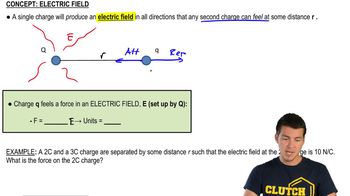
Intro to Electric Fields

Superposition Principle

The superposition principle states that the total electric field due to multiple charges is the vector sum of the individual fields produced by each charge. This principle is essential for deriving the expression for the electric field at any point on the x-axis, as it involves calculating the contributions from both charges placed at x = a and x = -a.
Recommended video:
Guided course
03:32
Superposition of Sinusoidal Wave Functions

Graphing Electric Fields

Graphing the electric field involves plotting the x-component of the field as a function of position along the x-axis. This requires understanding how the field varies with distance and direction, and how the contributions from each charge affect the overall field. The graph provides a visual representation of the field's behavior between -4a and +4a.
Recommended video:
Guided course
03:16
Intro to Electric Fields
Related Practice
Textbook Question

A point charge is placed at each corner of a square with side length aa. All charges have magnitude qq. Two of the charges are positive and two are negative (Fig. E21.4221.42). What is the direction of the net electric field at the center of the square due to the four charges, and what is its magnitude in terms of qq and aa?

Textbook Question

A 4.00-4.00-nC point charge is at the origin, and a second 5.00-5.00-nC point charge is on the xx-axis at x=0.800x = 0.800 m. Find the electric field (magnitude and direction) at each of the following points on the xx-axis: (i) x=0.200x = 0.200 m; (ii) x=1.20x = 1.20 m; (iii) x=0.200x = -0.200 m.

1
views
Textbook Question

A +8.75+8.75-mC point charge is glued down on a horizontal frictionless table. It is tied to a 6.50-6.50-mC point charge by a light, nonconducting 2.502.50-cm wire. A uniform electric field of magnitude 1.85×1081.85\(\times\)10^8 N/CN/C is directed parallel to the wire, as shown in Fig. E21.3421.34. What would the tension be if both charges were negative?

1
views
Textbook Question

Two positive point charges qq are placed on the xx-axis, one at x=ax = a and one at x=ax = -a. Find the magnitude and direction of the electric field at x=0x = 0.

Textbook Question

A +8.75+8.75-mC point charge is glued down on a horizontal frictionless table. It is tied to a 6.50-6.50-mC point charge by a light, nonconducting 2.502.50-cm wire. A uniform electric field of magnitude 1.85×1081.85\(\times\)10^8 N/CN/C is directed parallel to the wire, as shown in Fig. E21.3421.34. Find the tension in the wire.

1
views
Textbook Question

A 4.00-4.00-nC point charge is at the origin, and a second 5.00-5.00-nC point charge is on the xx-axis at x=0.800x = 0.800 m. Find the net electric force that the two charges would exert on an electron placed at each point in part (a). Note: Part (a) asked to find the electric field (magnitude and direction) at each of the following points on the xx-axis: (i) x=0.200x = 0.200 m; (ii) x=1.20x = 1.20 m; (iii) x=0.200x = -0.200 m.

1
views