Ch 21: Electric Charge and Electric Field
Young & Freedman Calc - University Physics 14th Edition
Young & Freedman Calc14th EditionUniversity PhysicsISBN: 9780321973610Not the one you use?Change textbook
Chapter 21, Problem 2

Lightning occurs when there is a flow of electric charge (principally electrons) between the ground and a thundercloud. The maximum rate of charge flow in a lightning bolt is about 20,00020,000 C/s; this lasts for 100100 ms or less. How much charge flows between the ground and the cloud in this time? How many electrons flow during this time?

Verified step by step guidance
1
First, identify the given values in the problem: the maximum rate of charge flow (current) is 20,000 C/s, and the time duration is 100 ms. Convert the time from milliseconds to seconds by dividing by 1000, so 100 ms = 0.1 s.
To find the total charge that flows, use the formula for charge flow: \( Q = I \times t \), where \( Q \) is the charge in coulombs, \( I \) is the current in amperes (C/s), and \( t \) is the time in seconds. Substitute the given values into the formula.
Calculate the total charge \( Q \) by multiplying the current (20,000 C/s) by the time (0.1 s). This will give you the total charge in coulombs that flows between the ground and the cloud.
Next, to find the number of electrons, use the relationship between charge and electrons: \( Q = n \times e \), where \( n \) is the number of electrons and \( e \) is the elementary charge (approximately \( 1.602 \times 10^{-19} \) C). Rearrange the formula to solve for \( n \): \( n = \frac{Q}{e} \).
Substitute the total charge \( Q \) calculated in the previous step and the value of the elementary charge \( e \) into the formula to find the number of electrons that flow during this time.

Verified video answer for a similar problem:

This video solution was recommended by our tutors as helpful for the problem above.
Video duration:
3m
Was this helpful?

Key Concepts

Here are the essential concepts you must grasp in order to answer the question correctly.

Electric Charge

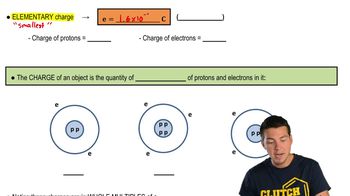
Electric charge is a fundamental property of matter that causes it to experience a force when placed in an electromagnetic field. It is measured in coulombs (C), and electrons carry a negative charge. Understanding charge flow is crucial for calculating the total charge transferred during lightning.
Recommended video:
Guided course
05:37
Electric Charge

Current and Charge Flow

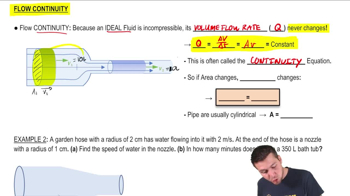
Current is the rate of flow of electric charge, measured in amperes (A), where 1 A equals 1 C/s. In the context of lightning, the current is given as 20,000 C/s, indicating the rapid movement of charge. To find the total charge transferred, multiply the current by the duration of the flow.
Recommended video:
Guided course
11:08
Flow Continuity

Electron Charge

The charge of a single electron is approximately -1.602 x 10^-19 coulombs. To determine the number of electrons transferred during lightning, divide the total charge by the charge of one electron. This calculation helps quantify the microscopic flow of electrons in the macroscopic event of lightning.
Recommended video:
Guided course
04:32
Electrons In Water (Using Density)