Ch 19: The First Law of Thermodynamics
Young & Freedman Calc - University Physics 14th Edition
Young & Freedman Calc14th EditionUniversity PhysicsISBN: 9780321973610Not the one you use?Change textbook
Chapter 19, Problem 30a

A player bounces a basketball on the floor, compressing it to 80.0%80.0\% of its original volume. The air (assume it is essentially N2 gas) inside the ball is originally at 20.020.0°C and 2.002.00 atm. The ball's inside diameter is 23.9 23.9 cm. What temperature does the air in the ball reach at its maximum compression? Assume the compression is adiabatic and treat the gas as ideal.

Verified step by step guidance
1
First, understand that the problem involves an adiabatic process, where no heat is exchanged with the surroundings. For an ideal gas undergoing an adiabatic process, the relation between pressure, volume, and temperature is given by the equation: \( P_1 V_1^\gamma = P_2 V_2^\gamma \), where \( \gamma \) (gamma) is the adiabatic index, which is 1.4 for diatomic gases like nitrogen.
Next, calculate the initial volume \( V_1 \) of the basketball. The volume of a sphere is given by \( V = \frac{4}{3} \pi r^3 \). Convert the diameter to radius by dividing by 2, and then convert to meters. Use this radius to find \( V_1 \).
Determine the final volume \( V_2 \) after compression. Since the ball is compressed to 80.0% of its original volume, \( V_2 = 0.8 \times V_1 \).
Use the adiabatic relation for temperature and volume: \( T_1 V_1^{\gamma-1} = T_2 V_2^{\gamma-1} \). Here, \( T_1 \) is the initial temperature in Kelvin. Convert the initial temperature from Celsius to Kelvin by adding 273.15.
Solve for the final temperature \( T_2 \) using the equation: \( T_2 = T_1 \left( \frac{V_1}{V_2} \right)^{\gamma-1} \). Substitute the known values for \( T_1 \), \( V_1 \), \( V_2 \), and \( \gamma \) to find \( T_2 \).

Verified video answer for a similar problem:

This video solution was recommended by our tutors as helpful for the problem above.
Video duration:
5m
Was this helpful?

Key Concepts

Here are the essential concepts you must grasp in order to answer the question correctly.

Adiabatic Process

An adiabatic process is a thermodynamic process in which no heat is exchanged with the surroundings. In such processes, any change in the internal energy of the system is due to work done on or by the system. For an ideal gas, this process is characterized by the equation PV^γ = constant, where γ is the heat capacity ratio (Cp/Cv).
Recommended video:
Guided course
06:13
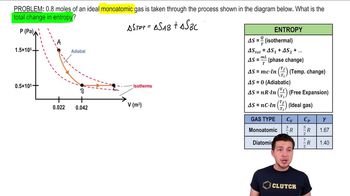
Entropy & Ideal Gas Processes

Ideal Gas Law

The ideal gas law is a fundamental equation in thermodynamics that relates the pressure, volume, and temperature of an ideal gas. It is expressed as PV = nRT, where P is pressure, V is volume, T is temperature, n is the number of moles, and R is the ideal gas constant. This law assumes that the gas particles do not interact and occupy no volume.
Recommended video:
Guided course
07:21
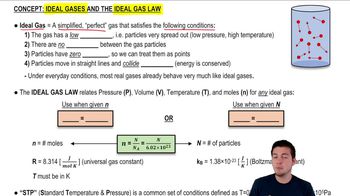
Ideal Gases and the Ideal Gas Law

Heat Capacity Ratio (γ)

The heat capacity ratio, denoted as γ (gamma), is the ratio of the heat capacity at constant pressure (Cp) to the heat capacity at constant volume (Cv). For diatomic gases like nitrogen (N2), γ is typically around 1.4. This ratio is crucial in adiabatic processes, as it determines how pressure and volume changes affect temperature.
Recommended video:
Guided course
17:42
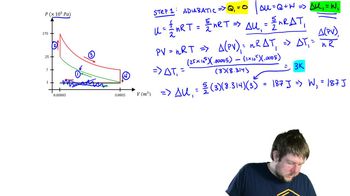
Finding the Compression Ratio
Related Practice
Textbook Question

A monatomic ideal gas that is initially at 1.50×1051.50\(\times\)10^5 Pa and has a volume of 0.08000.0800 m3 is compressed adiabatically to a volume of 0.04000.0400 m3. What is the final pressure?

1
views

Textbook Question

A cylinder contains 0.100 mol of an ideal monatomic gas. Initially the gas is at 1.00×1051.00\(\times\)10^5 Pa and occupies a volume of 2.50×1032.50\(\times\)10^{-3} m3. If the gas is allowed to expand to twice the initial volume, find the final temperature (in kelvins) and pressure of the gas if the expansion is (i) isothermal; (ii) isobaric; (iii) adiabatic.

1
views
Textbook Question

On a warm summer day, a large mass of air (atmospheric pressure 1.01×1051.01\(\times\)10^5 Pa) is heated by the ground to 26.026.0°C and then begins to rise through the cooler surrounding air. (This can be treated approximately as an adiabatic process; why?) Calculate the temperature of the air mass when it has risen to a level at which atmospheric pressure is only 0.850×1050.850\(\times\)10^5 Pa. Assume that air is an ideal gas, with g=1.40g = 1.40. (This rate of cooling for dry, rising air, corresponding to roughly 11 C° per 100100 m of altitude, is called the dry adiabatic lapse rate.)

Textbook Question

A monatomic ideal gas that is initially at 1.50×1051.50\(\times\)10^5 Pa and has a volume of 0.08000.0800 m3 is compressed adiabatically to a volume of 0.04000.0400 m3. What is the ratio of the final temperature of the gas to its initial temperature? Is the gas heated or cooled by this compression?

1
views
Textbook Question

The engine of a Ferrari F355 F1 sports car takes in air at 20.020.0°C and 1.001.00 atm and compresses it adiabatically to 0.09000.0900 times the original volume. The air may be treated as an ideal gas with g=1.40g = 1.40. Find the final temperature and pressure.

2
views