Ch 19: The First Law of Thermodynamics
Young & Freedman Calc - University Physics 14th Edition
Young & Freedman Calc14th EditionUniversity PhysicsISBN: 9780321973610Not the one you use?Change textbook
Chapter 19, Problem 18c

A cylinder contains 0.01000.0100 mol of helium at T=27.0T = 27.0°C. What accounts for the difference between your answers to parts (a) and (b)? In which case is more heat required? What becomes of the additional heat?
(a) How much heat is needed to raise the temperature to 67.067.0°C while keeping the volume constant? Draw a pVpV-diagram for this process.
(b) If instead the pressure of the helium is kept constant, how much heat is needed to raise the temperature from 27.027.0°C to 67.067.0°C? Draw a pVpV-diagram for this process.

Verified step by step guidance
1
Step 1: For part (a), use the formula for heat transfer at constant volume: Q = nC_vΔT, where n is the number of moles, C_v is the molar heat capacity at constant volume for helium, and ΔT is the change in temperature. Calculate ΔT by converting the temperatures from Celsius to Kelvin and finding the difference.
Step 2: For part (b), use the formula for heat transfer at constant pressure: Q = nC_pΔT, where C_p is the molar heat capacity at constant pressure for helium. Again, calculate ΔT by converting the temperatures from Celsius to Kelvin and finding the difference.
Step 3: To understand the difference in heat required between parts (a) and (b), note that C_p > C_v for any gas. This is because at constant pressure, the gas does work as it expands, requiring more heat input. Therefore, more heat is required in part (b).
Step 4: For part (d), the change in internal energy ΔU for an ideal gas is given by ΔU = nC_vΔT, regardless of whether the process is at constant volume or constant pressure. Calculate ΔU for both parts (a) and (b) using the same formula.
Step 5: Compare the changes in internal energy for parts (a) and (b). They should be the same because the change in internal energy for an ideal gas depends only on the temperature change, not on the process path. This illustrates the first law of thermodynamics, where the internal energy change is independent of the path taken.

Verified video answer for a similar problem:

This video solution was recommended by our tutors as helpful for the problem above.
Video duration:
8m
Was this helpful?

Key Concepts

Here are the essential concepts you must grasp in order to answer the question correctly.

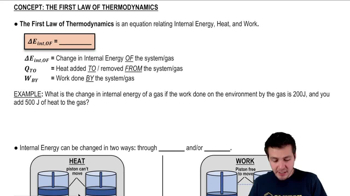
First Law of Thermodynamics

The First Law of Thermodynamics states that energy cannot be created or destroyed, only transferred or converted. In the context of this problem, it helps us understand how heat added to the system affects internal energy and work done by the gas. For a constant volume process, no work is done, so all heat goes into changing the internal energy.
Recommended video:
Guided course
08:04
The First Law of Thermodynamics

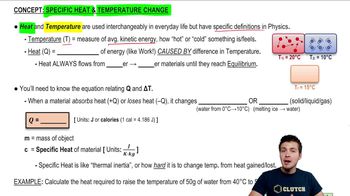
Specific Heat Capacity

Specific heat capacity is the amount of heat required to change the temperature of a substance by one degree Celsius per unit mass. For gases, it varies depending on whether the process is at constant volume (Cv) or constant pressure (Cp). This concept is crucial for calculating the heat needed in both scenarios described in the problem.
Recommended video:
Guided course
06:50
Specific Heat & Temperature Changes

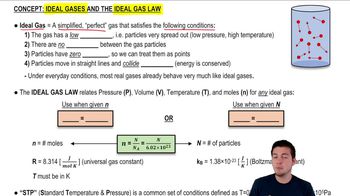
Ideal Gas Law

The Ideal Gas Law, PV = nRT, relates pressure, volume, and temperature of an ideal gas. It is essential for understanding how changes in temperature affect pressure and volume in the cylinder. In this problem, it helps determine the behavior of helium under constant volume and constant pressure conditions, influencing the heat calculations.
Recommended video:
Guided course
07:21
Ideal Gases and the Ideal Gas Law
Related Practice
Textbook Question

A cylinder contains 0.01000.0100 mol of helium at T=27.0T = 27.0°C. If instead the pressure of the helium is kept constant, how much heat is needed to raise the temperature from 27.027.0°C to 67.067.0°C? Draw a pVpV-diagram for this process.

2
views
Textbook Question

A cylinder contains 0.01000.0100 mol of helium at T=27.0T = 27.0°C. If the gas is ideal, what is the change in its internal energy in part (a)? In part (b)? How do the two answers compare? Why?

(a) How much heat is needed to raise the temperature to 67.067.0°C while keeping the volume constant? Draw a pVpV-diagram for this process.

(b) If instead the pressure of the helium is kept constant, how much heat is needed to raise the temperature from 27.027.0°C to 67.067.0°C? Draw a pVpV-diagram for this process.

1
views
Textbook Question

During an isothermal compression of an ideal gas, 410410 J of heat must be removed from the gas to maintain constant temperature. How much work is done by the gas during the process?

Textbook Question

An experimenter adds 970970 J of heat to 1.751.75 mol of an ideal gas to heat it from 10.010.0°C to 25.025.0°C at constant pressure. The gas does +223+223 J of work during the expansion. Calculate γ\(\gamma\) for the gas.

1
views
Textbook Question

A cylinder contains 0.01000.0100 mol of helium at T=27.0T = 27.0°C. How much heat is needed to raise the temperature to 67.067.0°C while keeping the volume constant? Draw a pVpV-diagram for this process.

1
views
Textbook Question

Heat QQ flows into a monatomic ideal gas, and the volume increases while the pressure is kept constant. What fraction of the heat energy is used to do the expansion work of the gas?

3
views