
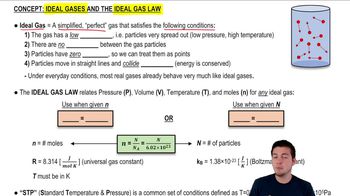
Calculate the density of the atmosphere at the surface of Mars (where the pressure is Pa and the temperature is typically K, with a CO2 atmosphere), Venus (with an average temperature of K and pressure of atm, with a CO2 atmosphere), and Saturn's moon Titan (where the pressure is atm and the temperature is °C, with a N2 atmosphere).
Helium gas with a volume of L, under a pressure of atm and at °C, is warmed until both pressure and volume are doubled. What is the final temperature?
Verified step by step guidance
Verified video answer for a similar problem:
Key Concepts
Ideal Gas Law
Temperature Conversion
Direct and Inverse Proportionality
A -L tank contains kg of helium at °C. The molar mass of helium is g/mol. How many moles of helium are in the tank?
A -L tank contains kg of helium at °C. The molar mass of helium is g/mol. What is the pressure in the tank, in pascals and in atmospheres?
Helium gas with a volume of L, under a pressure of atm and at °C, is warmed until both pressure and volume are doubled. How many grams of helium are there? The molar mass of helium is g/mol.
A cylindrical tank has a tight-fitting piston that allows the volume of the tank to be changed. The tank originally contains m3 of air at a pressure of atm. The piston is slowly pulled out until the volume of the gas is increased to m3. If the temperature remains constant, what is the final value of the pressure?
