
Ch 23: Electric Potential
Young & Freedman Calc - University Physics 14th Edition
Young & Freedman Calc14th EditionUniversity PhysicsISBN: 9780321973610Not the one you use?Change textbook
Chapter 23, Problem 42a

A very large plastic sheet carries a uniform charge density of 6.00-6.00 nC/m2 on one face. As you move away from the sheet along a line perpendicular to it, does the potential increase or decrease? How do you know, without doing any calculations? Does your answer depend on where you choose the reference point for potential?

Verified step by step guidance
1
Understand the concept of electric potential: Electric potential is related to the work done by an electric field in moving a charge from one point to another. It is a scalar quantity and is influenced by the charge distribution.
Consider the direction of the electric field: A uniformly charged sheet creates an electric field that is perpendicular to the surface of the sheet. For a negatively charged sheet, the electric field points towards the sheet.
Analyze the behavior of potential: As you move away from a negatively charged sheet, you are moving against the direction of the electric field. The potential decreases because work is done against the field to move a positive test charge away from the sheet.
Consider the reference point: The choice of reference point for potential does not affect the direction of change in potential. It only affects the absolute value of potential. The potential difference between two points is independent of the reference point.
Conclude the relationship: The potential decreases as you move away from the negatively charged sheet, and this conclusion is based on the direction of the electric field and the nature of work done against it.

Verified video answer for a similar problem:

This video solution was recommended by our tutors as helpful for the problem above.
Video duration:
2m
Was this helpful?

Key Concepts

Here are the essential concepts you must grasp in order to answer the question correctly.

Electric Field of a Charged Sheet

A uniformly charged infinite sheet creates a constant electric field perpendicular to its surface. The field's magnitude is independent of the distance from the sheet, and its direction is determined by the sign of the charge. For a negatively charged sheet, the field points towards the sheet, influencing potential changes as you move away.
Recommended video:
Guided course
06:28
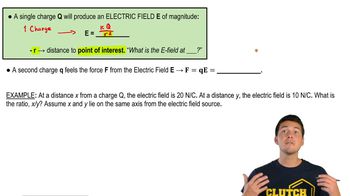
Electric Field due to a Point Charge

Electric Potential and Electric Field Relationship

Electric potential decreases in the direction of the electric field. Since the field from a negatively charged sheet points towards the sheet, moving away from it means moving against the field direction, leading to an increase in potential. This relationship is crucial for understanding potential changes without calculations.
Recommended video:
Guided course
07:33
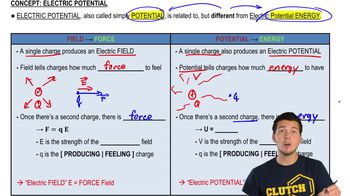
Electric Potential

Reference Point for Electric Potential

Electric potential is relative and depends on the chosen reference point. While the change in potential is consistent, the absolute value can vary based on where the reference point is set. However, the direction of potential change (increase or decrease) remains unaffected by the reference point choice.
Recommended video:
Guided course
07:31
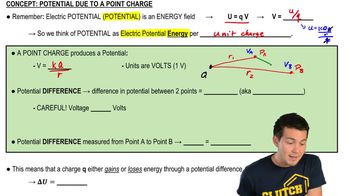
Potential Due To Point Charges
Related Practice
Textbook Question

A metal sphere with radius ra r_a is supported on an insulating stand at the center of a hollow, metal, spherical shell with radius rbr_b. There is charge +q+q on the inner sphere and charge q-q on the outer spherical shell. Use Er=[1/(4πϵ0)](q/r2)E_r = [1/(4πϵ_0 )](q/r^2) and the result from part (a) to find the electric field at a point outside the larger sphere at a distance rr from the center, where r>rbr > r_b. Note: Part (a) asked to calculate the potential V(r)V(r) for (i) r<rar < r_a; (ii) ra<r<rbr_a < r < r_b; (iii) r>rbr > r_b. (Hint: The net potential is the sum of the potentials due to the individual spheres.) Take VV to be zero when rr is infinite..

4
views
Textbook Question

A metal sphere with radius ra r_a is supported on an insulating stand at the center of a hollow, metal, spherical shell with radius rbr_b. There is charge +q+q on the inner sphere and charge q-q on the outer spherical shell. Use Er=V/r=(/r)(1/(4πϵ0)q/r)=[1/(4πϵ0)](q/r2)E_r=-∂V/∂r=(-∂/∂r) (1/(4πϵ_0 ) q/r)=[1/(4πϵ_0 )](q/r^2) and the result from part (a) to show that the electric field at any point between the spheres has magnitude E(r)=[Vab/(1/ra1/rb)](1/r2)E(r)=[V_ab/(1/r_a -1/r_b )](1/r^2). Note: Part (a) asked to calculate the potential V(r)V(r) for (i) r<rar < r_a; (ii) ra<r<rbr_a < r < r_b; (iii) r>rbr > r_b. (Hint: The net potential is the sum of the potentials due to the individual spheres.) Take VV to be zero when rr is infinite..

2
views
Textbook Question

Suppose the charge on the outer sphere is not q-q but a negative charge of different magnitude, say Q-Q. Show that the answers for parts (b) and (c) are the same as before but the answer for part (d) is different. Note: Part (a) asked to calculate the potential V(r)V(r) for (i) r<rar < r_a; (ii) ra<r<rbr_a < r < r_b; (iii) r>rbr > r_b. (Hint: The net potential is the sum of the potentials due to the individual spheres.) Take VV to be zero when rr is infinite. Part (b) asked to show that the potential of the inner sphere with respect to the outer is Vab=q/(4πϵ0)(1/ra1/rb)V_ab=q/(4πϵ_0 ) (1/r_a -1/r_b). Part (c) asked to use Er=V/r=(/r)(1/(4πϵ0)q/r)=[1/(4πϵ0)](q/r2)E_r=-∂V/∂r=(-∂/∂r) (1/(4πϵ_0 ) q/r)=[1/(4πϵ_0 )](q/r^2) and the result from part (a) to show that the electric field at any point between the spheres has magnitude E(r)=[Vab/(1/ra1/rb)](1/r2)E(r)=[V_ab/(1/r_a -1/r_b )](1/r^2). Part (d) asked to use Er=[1/(4πϵ0)](q/r2)E_r = [1/(4πϵ_0 )](q/r^2) and the result from part (a) to find the electric field at a point outside the larger sphere at a distance rr from the center, where r>rbr > r_b.

3
views