
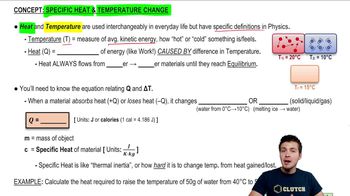
In very cold weather a significant mechanism for heat loss by the human body is energy expended in warming the air taken into the lungs with each breath. On a cold winter day when the temperature is -20°C, what amount of heat is needed to warm to body temperature (37°C) the 0.50 L of air exchanged with each breath? Assume that the specific heat of air is 1020 J/kg K and that 1.0 L of air has mass 1.3 × 10⁻³ kg.
You have 750 g of water at 10.0°C in a large insulated beaker. How much boiling water at 100.0°C must you add to this beaker so that the final temperature of the mixture will be 75°C?
Verified step by step guidance
Verified video answer for a similar problem:
Key Concepts
Specific Heat Capacity
Conservation of Energy
Heat Transfer in Mixtures
A copper calorimeter can with mass 0.100 kg contains 0.160 kg of water and 0.0180 kg of ice in thermal equilibrium at atmospheric pressure. If 0.750 kg of lead at 255°C is dropped into the calorimeter can, what is the final temperature? Assume that no heat is lost to the surroundings.
One suggested treatment for a person who has suffered a stroke is immersion in an ice-water bath at 0°C to lower the body temperature, which prevents damage to the brain. In one set of tests, patients were cooled until their internal temperature reached 32.0°C. To treat a 70.0 kg patient, what is the minimum amount of ice (at 0°C) you need in the bath so that its temperature remains at 0°C? The specific heat of the human body is 3480 J/kg C°, and recall that normal body temperature is 37.0°C.
A nail driven into a board increases in temperature. If we assume that 60% of the kinetic energy delivered by a 1.80 kg hammer with a speed of 7.80 m/s is transformed into heat that flows into the nail and does not flow out, what is the temperature increase of an 8.00 g aluminum nail after it is struck ten times?
A blacksmith cools a 1.20 kg chunk of iron, initially at 650.0°C, by trickling 15.0°C water over it. All of the water boils away, and the iron ends up at 120.0°C. How much water did the blacksmith trickle over the iron?
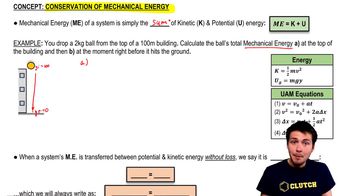
While painting the top of an antenna 225 m in height, a worker accidentally lets a 1.00-L water bottle fall from his lunchbox. The bottle lands in some bushes at ground level and does not break. If a quantity of heat equal to the magnitude of the change in mechanical energy of the water goes into the water, what is its increase in temperature?
