Ch 16: Sound & Hearing
Young & Freedman Calc - University Physics 14th Edition
Young & Freedman Calc14th EditionUniversity PhysicsISBN: 9780321973610Not the one you use?Change textbook
Chapter 16, Problem 40

Two guitarists attempt to play the same note of wavelength 64.8 cm at the same time, but one of the instruments is slightly out of tune and plays a note of wavelength 65.2 cm instead. What is the frequency of the beats these musicians hear when they play together?

Verified step by step guidance
1
First, understand the concept of beats. Beats occur when two sound waves of slightly different frequencies interfere with each other, resulting in a fluctuating sound intensity. The beat frequency is the absolute difference between the frequencies of the two waves.
Convert the wavelengths of the notes played by the guitarists into frequencies. Use the formula: f=vλ, where f is the frequency, v is the speed of sound in air (approximately 343 m/s), and λ is the wavelength.
Calculate the frequency of the first note using its wavelength of 64.8 cm. Convert the wavelength from centimeters to meters by dividing by 100, then apply the formula: f=3430.648.
Calculate the frequency of the second note using its wavelength of 65.2 cm. Similarly, convert the wavelength to meters and apply the formula: f=3430.652.
Determine the beat frequency by finding the absolute difference between the two frequencies calculated in the previous steps. Use the formula: fbeat=|f1-f2|, where f1 and f2 are the frequencies of the two notes.

Verified video answer for a similar problem:

This video solution was recommended by our tutors as helpful for the problem above.
Video duration:
4m
Was this helpful?

Key Concepts

Here are the essential concepts you must grasp in order to answer the question correctly.

Wave Interference

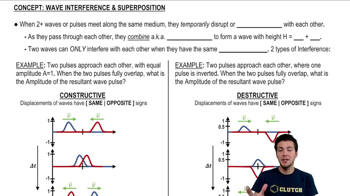
Wave interference occurs when two waves meet while traveling along the same medium. The principle of superposition states that the resultant wave is the sum of the individual waves. In this context, the interference between the two sound waves of slightly different wavelengths results in a phenomenon known as beats.
Recommended video:
Guided course
03:47
Wave Interference & Superposition

Beat Frequency

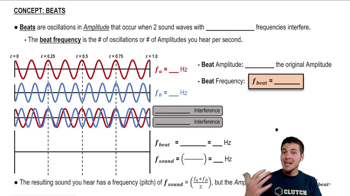
Beat frequency is the frequency at which the amplitude of the resultant wave fluctuates due to the interference of two waves with slightly different frequencies. It is calculated as the absolute difference between the frequencies of the two waves. This concept explains the periodic variation in sound intensity heard when the two guitarists play together.
Recommended video:

Relationship Between Wavelength and Frequency

The frequency of a wave is inversely proportional to its wavelength, given by the equation f = v/λ, where f is frequency, v is the speed of sound, and λ is the wavelength. Understanding this relationship is crucial for calculating the frequencies of the notes played by the guitarists, which are needed to determine the beat frequency.
Recommended video:
Guided course
03:43
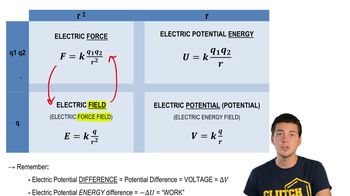
Relationships Between Force, Field, Energy, Potential
Related Practice
Textbook Question

A railroad train is traveling at 30.0 m/s in still air. The frequency of the note emitted by the train whistle is 352 Hz. What frequency is heard by a passenger on a train moving in the opposite direction to the first at 18.0 m/s and approaching the first?

2
views
Textbook Question

The motors that drive airplane propellers are, in some cases, tuned by using beats. The whirring motor produces a sound wave having the same frequency as the propeller. (a) If one single-bladed propeller is turning at 575 rpm and you hear 2.0-Hz beats when you run the second propeller, what are the two possible frequencies (in rpm) of the second propeller? (b) Suppose you increase the speed of the second propeller slightly and find that the beat frequency changes to 2.1 Hz. In part (a), which of the two answers was the correct one for the frequency of the second single-bladed propeller? How do you know?

1
views
Textbook Question

Two small stereo speakers are driven in step by the same variable-frequency oscillator. Their sound is picked up by a microphone arranged as shown in Fig. E16.39. For what frequencies does their sound at the speakers produce constructive interference?

1
views
Textbook Question

Two organ pipes, open at one end but closed at the other, are each 1.14 m long. One is now lengthened by 2.00 cm. Find the beat frequency that they produce when playing together in their fundamentals.

2
views
Textbook Question

Two loudspeakers, A and B (Fig. E16.35), are driven by the same amplifier and emit sinusoidal waves in phase. Speaker B is 2.00 m to the right of speaker A. Consider point Q along the extension of the line connecting the speakers, 1.00 m to the right of speaker B. Both speakers emit sound waves that travel directly from the speaker to point Q. What is the lowest frequency for which constructive interference occurs at point Q?

4
views
Textbook Question

Two loudspeakers, A and B (Fig. E16.35), are driven by the same amplifier and emit sinusoidal waves in phase. Speaker B is 2.00 m to the right of speaker A. Consider point Q along the extension of the line connecting the speakers, 1.00 m to the right of speaker B. Both speakers emit sound waves that travel directly from the speaker to point Q. What is the lowest frequency for which destructive interference occurs at point Q?

3
views