Ch 15: Mechanical Waves
Young & Freedman Calc - University Physics 14th Edition
Young & Freedman Calc14th EditionUniversity PhysicsISBN: 9780321973610Not the one you use?Change textbook
Chapter 15, Problem 42b

The wave function of a standing wave is y(x,t)=4.44 mmsin[(32.5 rad/m)x]sin[(754rad/s)t]y(x,t)=4.44\(\text{ mm}\]\sin\)[(32.5\(\text{ rad/m}\))x]\(\sin\)[(754\(\text{rad/s}\))t]. For the two traveling waves that make up this standing wave, find the wavelength.

Verified step by step guidance
1
Understand that a standing wave is formed by the superposition of two traveling waves moving in opposite directions. The given wave function is y(x, t) = 4.44 mm sin[(32.5 rad/m)x] sin[(754 rad/s)t].
Identify the wave number (k) from the wave function. The wave number is given as 32.5 rad/m. The wave number is related to the wavelength (λ) by the formula: k = 2π/λ.
Rearrange the formula to solve for the wavelength (λ): λ = 2π/k.
Substitute the given wave number (k = 32.5 rad/m) into the formula: λ = 2π/32.5 rad/m.
Calculate the wavelength using the formula. This will give you the wavelength of the traveling waves that make up the standing wave.

Verified video answer for a similar problem:

This video solution was recommended by our tutors as helpful for the problem above.
Video duration:
2m
Was this helpful?

Key Concepts

Here are the essential concepts you must grasp in order to answer the question correctly.

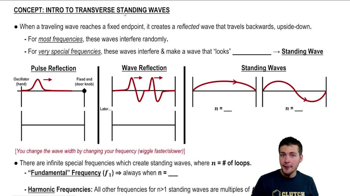
Standing Waves

Standing waves are formed by the superposition of two traveling waves moving in opposite directions with the same frequency and amplitude. They are characterized by nodes, where the wave amplitude is always zero, and antinodes, where the amplitude is maximum. Understanding standing waves is crucial for analyzing the given wave function.
Recommended video:
Guided course
07:58
Intro to Transverse Standing Waves

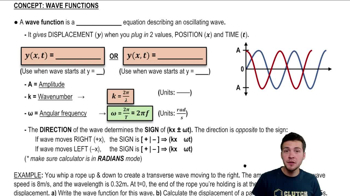
Wave Function

A wave function describes the displacement of a wave at any point in space and time. In the given function y(x, t) = 4.44 mm sin[(32.5 rad/m)x] sin[(754 rad/s)t], the spatial part sin[(32.5 rad/m)x] and the temporal part sin[(754 rad/s)t] indicate the wave's behavior in space and time, respectively. This function is essential for identifying properties like wavelength and frequency.
Recommended video:
Guided course
08:30
Intro to Wave Functions

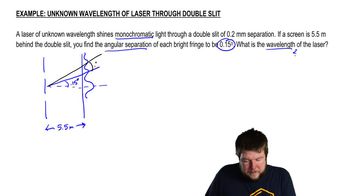
Wavelength

Wavelength is the distance between consecutive points of a wave in phase, such as crests or troughs. It is inversely related to the wave number, which is given in the wave function as 32.5 rad/m. The wavelength (λ) can be calculated using the formula λ = 2π/k, where k is the wave number. Understanding this relationship is key to solving the problem.
Recommended video:
Guided course
05:42
Unknown Wavelength of Laser through Double Slit
Related Practice
Textbook Question

The wave function of a standing wave is y(x,t)=4.44 mmsin[(32.5 rad/m)x]sin[(754rad/s)t]y(x,t)=4.44\(\text{ mm}\]\sin\)[(32.5\(\text{ rad/m}\))x]\(\sin\)[(754\(\text{rad/s}\))t]. For the two traveling waves that make up this standing wave, find the frequency.

1
views
Textbook Question

One string of a certain musical instrument is 75.0 cm long and has a mass of 8.75 g. It is being played in a room where the speed of sound is 344 m/s. (a) To what tension must you adjust the string so that, when vibrating in its second overtone, it produces sound of wavelength 0.765 m? (Assume that the break-ing stress of the wire is very large and isn't exceeded.) (b) What frequency sound does this string produce in its fundamental mode of vibration?

2
views
Textbook Question

CALC. A thin, taut string tied at both ends and oscillating in its third harmonic has its shape described by the equation y(x,t)=(5.60 cm)sin[(0.0340 rad/cm)x]sin[(50.0 rad/s)t]y(x,t)=(5.60\(\text{ cm}\))\(\sin\)[(0.0340\(\text{ rad/cm}\))x]\(\sin\)[(50.0\(\text{ rad/s}\))t], where the origin is at the left end of the string, the xx-axis is along the string, and the yy-axis is perpendicular to the string. Draw a sketch that shows the standing-wave pattern.

Textbook Question

The wave function of a standing wave is y(x,t)=4.44 mmsin[(32.5 rad/m)x]sin[(754rad/s)t]y(x,t)=4.44\(\text{ mm}\]\sin\)[(32.5\(\text{ rad/m}\))x]\(\sin\)[(754\(\text{rad/s}\))t]. For the two traveling waves that make up this standing wave, find the amplitude.

1
views
Textbook Question

A piano tuner stretches a steel piano wire with a tension of 800 N. The steel wire is 0.400 m long and has a mass of 3.00 g. What is the frequency of its fundamental mode of vibration?

1
views
Textbook Question

The wave function of a standing wave is y(x,t)=4.44 mmsin[(32.5 rad/m)x]sin[(754rad/s)t]y(x,t)=4.44\(\text{ mm}\]\sin\)[(32.5\(\text{ rad/m}\))x]\(\sin\)[(754\(\text{rad/s}\))t]. For the two traveling waves that make up this standing wave, find the wave speed.

1
views