

Ch 14: Periodic Motion
Young & Freedman Calc - University Physics 14th Edition
Young & Freedman Calc14th EditionUniversity PhysicsISBN: 9780321973610Not the one you use?Change textbook
Chapter 14, Problem 26

A small block is attached to an ideal spring and is moving in SHM on a horizontal, frictionless surface. The amplitude of the motion is 0.250 m and the period is 3.20 s. What are the speed and acceleration of the block when x = 0.160 m?

Verified step by step guidance
1
Start by understanding the problem: We have a block undergoing simple harmonic motion (SHM) with a given amplitude and period. We need to find the speed and acceleration at a specific displacement.
Use the formula for the angular frequency \( \omega \) of SHM: \( \omega = \frac{2\pi}{T} \), where \( T \) is the period. Substitute \( T = 3.20 \) s to find \( \omega \).
The velocity \( v \) in SHM at a displacement \( x \) is given by \( v = \omega \sqrt{A^2 - x^2} \), where \( A \) is the amplitude. Substitute \( A = 0.250 \) m and \( x = 0.160 \) m to find the expression for \( v \).
The acceleration \( a \) in SHM at a displacement \( x \) is given by \( a = -\omega^2 x \). Substitute \( x = 0.160 \) m and the previously calculated \( \omega \) to find the expression for \( a \).
Review the signs and units: Ensure that the acceleration is negative, indicating it is directed towards the equilibrium position, and check that all units are consistent throughout the calculations.

Verified video answer for a similar problem:

This video solution was recommended by our tutors as helpful for the problem above.
Video duration:
9m
Was this helpful?

Key Concepts

Here are the essential concepts you must grasp in order to answer the question correctly.

Simple Harmonic Motion (SHM)

Simple Harmonic Motion is a type of periodic motion where the restoring force is directly proportional to the displacement and acts in the direction opposite to that of displacement. It is characterized by sinusoidal oscillations, with parameters such as amplitude, period, and frequency defining the motion. In this scenario, the block's motion is governed by these principles.
Recommended video:
Guided course
07:52
Simple Harmonic Motion of Pendulums

Amplitude and Period

Amplitude in SHM is the maximum displacement from the equilibrium position, while the period is the time taken for one complete cycle of motion. Here, the amplitude is 0.250 m, indicating the furthest point from equilibrium, and the period is 3.20 s, which helps determine the frequency and angular frequency of the motion, crucial for calculating speed and acceleration.
Recommended video:
Guided course
06:28
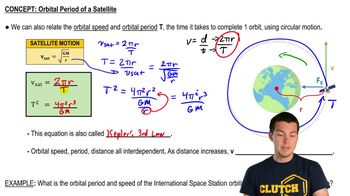
Satellite Period

Kinematics of SHM

The kinematics of SHM involves calculating the velocity and acceleration at any point in the motion. The velocity is maximum at the equilibrium position and zero at the amplitude, while acceleration is maximum at the amplitude and zero at equilibrium. Using the displacement (x = 0.160 m), we can apply SHM equations to find the instantaneous speed and acceleration of the block.
Recommended video:
Guided course
08:25
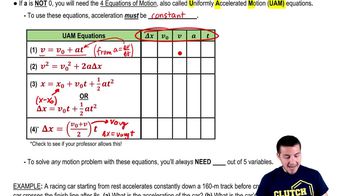
Kinematics Equations