Ch 14: Periodic Motion
Young & Freedman Calc - University Physics 14th Edition
Young & Freedman Calc14th EditionUniversity PhysicsISBN: 9780321973610Not the one you use?Change textbook
Chapter 14, Problem 1a

Music. When a person sings, his or her vocal cords vibrate in a repetitive pattern that has the same frequency as the note that is sung. If someone sings the note B flat, which has a frequency of 466 Hz, how much time does it take the person's vocal cords to vibrate through one complete cycle, and what is the angular frequency of the cords?

Verified step by step guidance
1
To find the time it takes for one complete cycle of vibration, we need to calculate the period of the vibration. The period \( T \) is the reciprocal of the frequency \( f \). Use the formula: \( T = \frac{1}{f} \).
Substitute the given frequency of the note B flat, which is 466 Hz, into the formula: \( T = \frac{1}{466} \). This will give you the period in seconds.
Next, to find the angular frequency \( \omega \), use the relationship between angular frequency and frequency: \( \omega = 2\pi f \).
Substitute the frequency \( f = 466 \) Hz into the formula: \( \omega = 2\pi \times 466 \). This will give you the angular frequency in radians per second.
These calculations will provide you with the time for one complete cycle and the angular frequency of the vocal cords when singing the note B flat.

Verified video answer for a similar problem:

This video solution was recommended by our tutors as helpful for the problem above.
Video duration:
3m
Was this helpful?

Key Concepts

Here are the essential concepts you must grasp in order to answer the question correctly.

Frequency

Frequency refers to the number of cycles or vibrations per unit of time, typically measured in Hertz (Hz). In this context, the frequency of 466 Hz indicates that the vocal cords complete 466 cycles every second when singing the note B flat. Understanding frequency is crucial for determining the time taken for one complete cycle.
Recommended video:
Guided course
05:08
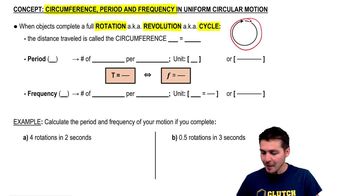
Circumference, Period, and Frequency in UCM

Period

The period is the duration of time it takes to complete one full cycle of vibration. It is the reciprocal of frequency, calculated as 1/frequency. For a frequency of 466 Hz, the period is approximately 0.00215 seconds, indicating the time taken for the vocal cords to complete one cycle.
Recommended video:
Guided course
06:28
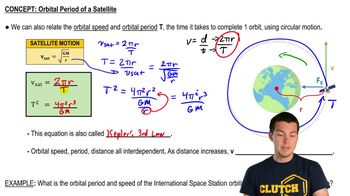
Satellite Period

Angular Frequency

Angular frequency is a measure of how quickly an object rotates or oscillates, expressed in radians per second. It is related to the frequency by the formula ω = 2πf, where ω is the angular frequency and f is the frequency. For a frequency of 466 Hz, the angular frequency is approximately 2928 radians per second, describing the rate of oscillation of the vocal cords.
Recommended video:
Guided course
05:08
Circumference, Period, and Frequency in UCM