
Textbook Question
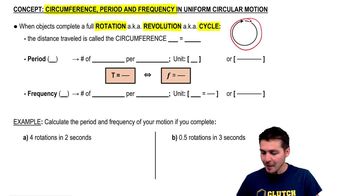
A 0.400-kg object undergoing SHM has ax = -1.80 m/s2 when x = 0.300 m. What is the time for one oscillation?
1
views
 Verified step by step guidance

 07:52
07:52
 05:08
05:08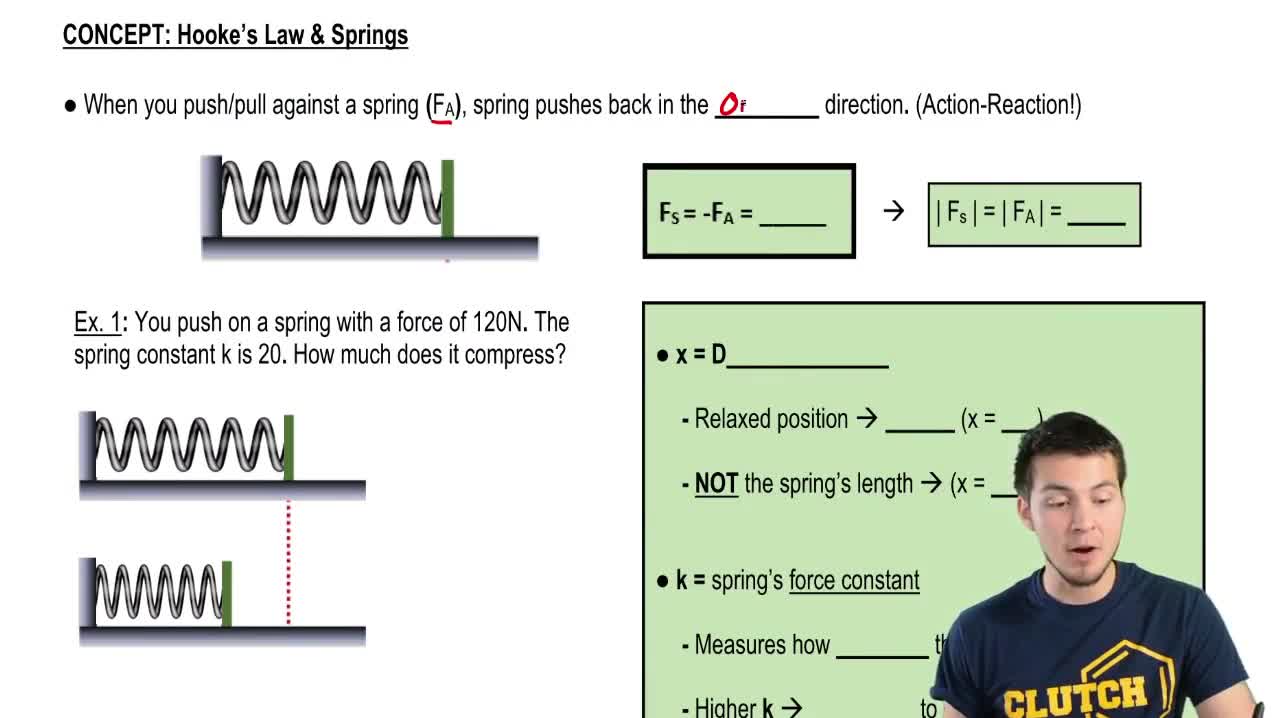 05:27
05:27A 0.400-kg object undergoing SHM has ax = -1.80 m/s2 when x = 0.300 m. What is the time for one oscillation?
For the oscillating object in Fig. E14.4, what is its maximum speed?
A small block is attached to an ideal spring and is moving in SHM on a horizontal, frictionless surface. When the amplitude of the motion is 0.090 m, it takes the block 2.70 s to travel from x = 0.090 m to x = -0.090 m. If the amplitude is doubled, to 0.180 m, how long does it take the block to travel from x = 0.090 m to x = -0.090 m?
Weighing Astronauts. This procedure has been used to 'weigh' astronauts in space: A 42.5-kg chair is attached to a spring and allowed to oscillate. When it is empty, the chair takes 1.30 s to make one complete vibration. But with an astronaut sitting in it, with her feet off the floor, the chair takes 2.54 s for one cycle. What is the mass of the astronaut?
A mass on a spring has velocity as a function of time given by . What are the amplitude and the maximum acceleration of the mass?
For the oscillating object in Fig. E14.4, what is its maximum acceleration?