
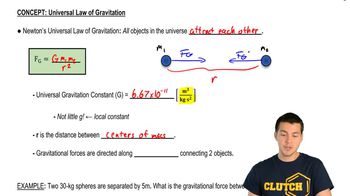
A typical adult human has a mass of about 70 kg. (a) What force does a full moon exert on such a human when it is directly overhead with its center 378,000 km away? (b) Compare this force with the force exerted on the human by the earth
The mass of Venus is 81.5% that of the earth, and its radius is 94.9% that of the earth. Compute the acceleration due to gravity on the surface of Venus from these data.
Verified step by step guidance
Verified video answer for a similar problem:
Key Concepts
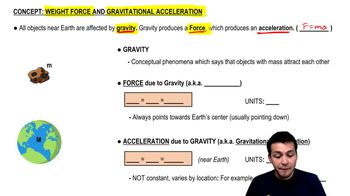
Gravitational Acceleration
Mass and Radius Proportions
Universal Gravitational Constant
Titania, the largest moon of the planet Uranus, has 1/8 the radius of the earth and 1/1700 the mass of the earth. What is the average density of Titania? (This is less than the density of rock, which is one piece of evidence that Titania is made primarily of ice.)
The mass of Venus is 81.5% that of the earth, and its radius is 94.9% that of the earth. If a rock weighs 75.0 N on earth, what would it weigh at the surface of Venus?
The point masses m and 2m lie along the x-axis, with m at the origin and 2m at x = L. A third point mass M is moved along the x-axis. At what point is the net gravitational force on M due to the other two masses equal to zero?
Titania, the largest moon of the planet Uranus, has 1/8 the radius of the earth and 1/1700 the mass of the earth. What is the acceleration due to gravity at the surface of Titania?
At what distance above the surface of the earth is the acceleration due to the earth's gravity 0.980 m/s2 if the acceleration due to gravity at the surface has magnitude 9.80 m/s2 ?
