

Astronomers have observed a small, massive object at the center of our Milky Way galaxy. A ring of material orbits this massive object; the ring has a diameter of about 15 light-years and an orbital speed of about 200 km/s. Observations of stars, as well as theories of the structure of stars, suggest that it is impossible for a single star to have a mass of more than about 50 solar masses. Can this massive object be a single, ordinary star?
Ch 13: Gravitation
Young & Freedman Calc14th EditionUniversity PhysicsISBN: 9780321973610Not the one you use?Change textbook
Chapter 13, Problem 40b
In 2005 astronomers announced the discovery of a large black hole in the galaxy Markarian 766 having clumps of matter orbiting around once every 27 hours and moving at 30,000 km/s. What is the mass of this black hole, assuming circular orbits? Express your answer in kilograms and as a multiple of our sun's mass.
Verified step by step guidance1
To find the mass of the black hole, we can use Kepler's third law of planetary motion, which relates the orbital period and the radius of the orbit to the mass of the central object. The formula is: \( T^2 = \frac{4\pi^2}{G M} r^3 \), where \( T \) is the orbital period, \( G \) is the gravitational constant, \( M \) is the mass of the black hole, and \( r \) is the radius of the orbit.
First, convert the orbital period from hours to seconds. Since there are 3600 seconds in an hour, multiply 27 hours by 3600 to get the period in seconds.
Next, use the given orbital speed \( v = 30,000 \text{ km/s} \) to find the radius of the orbit. The relationship between speed, radius, and period for circular motion is \( v = \frac{2\pi r}{T} \). Rearrange this to solve for \( r \): \( r = \frac{vT}{2\pi} \).
Substitute the values of \( v \), \( T \), and \( G = 6.674 \times 10^{-11} \text{ m}^3\text{kg}^{-1}\text{s}^{-2} \) into the rearranged Kepler's third law formula to solve for the mass \( M \): \( M = \frac{4\pi^2 r^3}{G T^2} \).
Finally, to express the mass of the black hole as a multiple of the sun's mass, divide the calculated mass by the mass of the sun, \( M_{\odot} = 1.989 \times 10^{30} \text{ kg} \).

Verified video answer for a similar problem:
This video solution was recommended by our tutors as helpful for the problem above.
Video duration:
4mWas this helpful?
Key Concepts
Here are the essential concepts you must grasp in order to answer the question correctly.
Gravitational Force and Circular Orbits
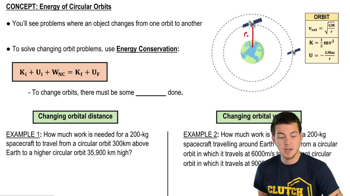
In a circular orbit, the gravitational force provides the necessary centripetal force to keep an object in orbit. The gravitational force between two masses is given by Newton's law of universal gravitation, F = G * (m1 * m2) / r^2, where G is the gravitational constant, m1 and m2 are the masses, and r is the distance between their centers. This concept is crucial for understanding how the mass of the black hole can be determined from the orbital motion of the clumps of matter.
Recommended video:
Guided course
Energy of Circular Orbits
Kepler's Third Law of Planetary Motion
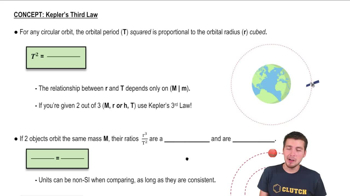
Kepler's Third Law states that the square of the orbital period (T) of a planet is directly proportional to the cube of the semi-major axis (r) of its orbit, T^2 ∝ r^3. For circular orbits, this can be used to relate the period of orbit to the mass of the central object. This law helps in calculating the mass of the black hole by using the period of the orbit and the velocity of the clumps of matter.
Recommended video:
Guided course
Kepler's Third Law
Mass of the Sun
The mass of the Sun is a standard unit of mass in astronomy, approximately 1.989 x 10^30 kilograms. When expressing the mass of astronomical objects, such as black holes, it is often useful to express them as multiples of the Sun's mass for easier comparison and understanding. This concept is essential for converting the calculated mass of the black hole into a more comprehensible form.
Recommended video:
Guided course
Mass Spectrometers
Related Practice
Textbook Question
1
views
Textbook Question
Cosmologists have speculated that black holes the size of a proton could have formed during the early days of the Big Bang when the universe began. If we take the diameter of a proton to be 1.0 × 10⁻¹⁵ m, what would be the mass of a mini black hole?
1
views
Textbook Question
In 2005 astronomers announced the discovery of a large black hole in the galaxy Markarian 766 having clumps of matter orbiting around once every 27 hours and moving at 30,000 km/s. How far are these clumps from the center of the black hole?
2
views
Textbook Question
In 2005 astronomers announced the discovery of a large black hole in the galaxy Markarian 766 having clumps of matter orbiting around once every 27 hours and moving at 30,000 km/s. What is the radius of its event horizon?
2
views
