
Ch 13: Gravitation
Young & Freedman Calc - University Physics 14th Edition
Young & Freedman Calc14th EditionUniversity PhysicsISBN: 9780321973610Not the one you use?Change textbook
Chapter 13, Problem 33a

A uniform, solid, 1000.0-kg sphere has a radius of 5.00 m. Find the gravitational force this sphere exerts on a 2.00-kg point mass placed at the following distances from the center of the sphere: (i) 5.01 m, (ii) 2.50 m.

Verified step by step guidance
1
Step 1: Understand the problem. We need to calculate the gravitational force exerted by a sphere on a point mass at two different distances. The gravitational force can be calculated using Newton's law of universal gravitation.
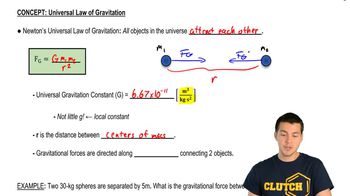
Step 2: Recall the formula for gravitational force: F = (GmM)r2, where G is the gravitational constant, m is the mass of the point mass, M is the mass of the sphere, and r is the distance from the center of the sphere to the point mass.
Step 3: For part (i), where the distance is 5.01 m, use the formula directly since the point mass is outside the sphere. Substitute G = 6.674 imes 10^{-11} \(\text{ N m}\)^2/\(\text{kg}\)^2, m = 2.00 \(\text{ kg}\), M = 1000.0 \(\text{ kg}\), and r = 5.01 \(\text{ m}\) into the formula.
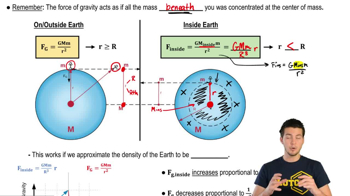
Step 4: For part (ii), where the distance is 2.50 m, the point mass is inside the sphere. According to the shell theorem, only the mass within the radius of 2.50 m contributes to the gravitational force. Calculate the mass of the sphere within this radius using the volume ratio: M' = M imes rac{(2.50)^3}{(5.00)^3}.
Step 5: Use the gravitational force formula again for part (ii) with the new mass M' and distance r = 2.50 \(\text{ m}\). Substitute the values into the formula to find the gravitational force.

Verified video answer for a similar problem:

This video solution was recommended by our tutors as helpful for the problem above.
Video duration:
9m
Was this helpful?

Key Concepts

Here are the essential concepts you must grasp in order to answer the question correctly.

Newton's Law of Universal Gravitation

Newton's Law of Universal Gravitation states that every point mass attracts every other point mass in the universe with a force that is directly proportional to the product of their masses and inversely proportional to the square of the distance between their centers. The formula is F = G * (m1 * m2) / r^2, where G is the gravitational constant.
Recommended video:
Guided course
04:05
Universal Law of Gravitation

Shell Theorem

The Shell Theorem, derived from Newton's laws, states that a uniform spherical shell of matter attracts a particle outside the shell as if all the shell's mass were concentrated at its center. Inside the shell, the gravitational force is zero. This theorem is crucial for calculating gravitational forces at different distances from a sphere's center.
Recommended video:
Guided course
13:46
Parallel Axis Theorem

Gravitational Field Inside a Sphere

For a point mass inside a uniform solid sphere, the gravitational force is determined only by the mass within the radius of the point mass. The force is proportional to the distance from the center, as the mass outside this radius does not contribute to the gravitational force. This concept helps in calculating the force at a distance less than the sphere's radius.
Recommended video:
Guided course
9:26
Gravitational Force Inside the Earth
Related Practice
Textbook Question

A uniform, spherical, 1000.0 kg1000.0\(\text{ kg}\) shell has a radius of 5.00 m5.00\(\text{ m}\). Sketch a qualitative graph of the magnitude of the gravitational force this sphere exerts on a point mass m as a function of the distance rr of mm from the center of the sphere. Include the region from r=0r = 0 to rr\(\to\]\infty\).

1
views
Textbook Question

Consider the ringshaped body of Fig. E13.35. A particle with mass m is placed a distance x from the center of the ring, along the line through the center of the ring and perpendicular to its plane. (a) Calculate the gravitational potential energy U of this system. Take the potential energy to be zero when the two objects are far apart. (b) Show that your answer to part (a) reduces to the expected result when x is much larger than the radius a of the ring. (c) Use Fx = -dU/dx to find the magnitude and direction of the force on the particle (see Section 7.4). (d) Show that your answer to part (c) reduces to the expected result when x is much larger than a. (e) What are the values of U and Fx when x = 0? Explain why these results make sense.

3
views
Textbook Question

A thin, uniform rod has length L and mass M. A small uniform sphere of mass m is placed a distance x from one end of the rod, along the axis of the rod (Fig. E13.34). Calculate the gravitational potential energy of the rod–sphere system. Take the potential energy to be zero when the rod and sphere are infinitely far apart. Show that your answer reduces to the expected result when x is much larger than L.

1
views
Textbook Question

A thin, uniform rod has length L and mass M. A small uniform sphere of mass m is placed a distance x from one end of the rod, along the axis of the rod (Fig. E13.34). Use Fx = -dU/dx to find the magnitude and direction of the gravitational force exerted on the sphere by the rod (see Section 7.4). Show that your answer reduces to the expected result when x is much larger than L.

2
views
Textbook Question

On October 15, 2001, a planet was discovered orbiting around the star HD 68988. Its orbital distance was measured to be 10.5 million kilometers from the center of the star, and its orbital period was estimated at 6.3 days. What is the mass of HD 68988? Express your answer in kilograms and in terms of our sun's mass.

1
views
Textbook Question

A uniform, spherical, 1000.0-kg shell has a radius of 5.00 m. Find the gravitational force this shell exerts on a 2.00-kg point mass placed at the following distances from the center of the shell: (i) 5.01 m, (ii) 4.99 m, (iii) 2.72 m.